

A virtual tour event planner portfolio is a curated collection of immersive 360-degree venue tours, paired with professional context and conversion-focused calls to action, designed to showcase your event planning expertise and accelerate client bookings. This format goes well beyond a traditional photo gallery. Where static images show a room, a 360-degree interactive portfolio lets prospects walk the space, evaluate capacity, and picture their event before a single call is made. Platforms like Simple Virtual Tour and Invision Studio have demonstrated that 360° tours increase qualified inquiries and speed up booking decisions by allowing clients to evaluate layouts and capacities virtually. For event planners and marketers, that means fewer wasted discovery calls and more clients who arrive ready to commit.
What makes a high-converting virtual tour event planner portfolio?

The industry term for what you are building is an interactive event portfolio, and the best ones function as decision-path assets rather than galleries. Each entry should guide a prospect logically from "Does this venue fit my needs?" to "How do I book?" without requiring a human to intervene at every step.
Here are the core components every high-performing portfolio entry needs:
- 360-degree virtual tour of the venue. Cover multiple room configurations, outdoor spaces, and amenity areas. A corporate client evaluating a 200-person conference needs to see the breakout rooms, not just the main hall.
- Event context and brief. State the event type, guest count, client objectives, and any logistical challenges you solved. Portfolio entries structured as evidence with client context and measurable results convert better than simple photo galleries.
- Outcome-oriented hotspot labels. Hotspots inside the tour should answer buyer questions in real time. Label a catering station with capacity notes. Mark a stage area with AV specs. These micro-answers reduce friction and keep prospects engaged.
- Embedded calls to action. Fixed buttons reading "Check availability" or "Get a proposal" should appear persistently throughout the tour. Embedded CTAs with calendar overlays or CRM-integrated forms convert browsers into leads without requiring a follow-up email.
- Captions with commercial context. Every image or tour scene should carry a caption that includes guest count, venue name, and a logistical note. Captions that add commercial context transform images into professional evidence and shorten client decision timelines.
- Analytics tracking. Embed heatmaps and view-count tracking into each tour so you know which rooms prospects linger in and which CTAs they click. This data tells you what to improve and what to replicate.
Pro Tip: Build each portfolio entry as if your best salesperson wrote it. The tour should answer the top five questions a prospect asks on a discovery call, so that by the time they contact you, they are already sold on the venue.
How to structure your portfolio to attract and convert ideal clients
Organization is the difference between a portfolio that qualifies leads and one that confuses them. The most effective structure groups entries by event type or client segment, not by date or venue name.
- Define your client segments first. Decide whether you serve weddings, corporate conferences, product launches, galas, or a combination. Each segment has different decision criteria. A wedding client wants emotional resonance and aesthetic detail. A corporate procurement manager wants capacity data, AV specs, and logistical proof.
- Create a dedicated section for each segment. Label sections clearly: "Corporate Events," "Weddings," "Social Galas." Prospects self-qualify faster when they can navigate directly to relevant examples. Portfolios emphasizing operational context resonate especially with corporate decision-makers who seek transparency and professional evidence.
- Balance visuals with structured case studies. Each entry should include the tour, a brief written case study (150 to 200 words), and one or two client testimonials. The tour provides the emotional experience; the case study provides the rational justification.
- Update entries at least quarterly. Add new tours as you complete events. Retire outdated entries that no longer reflect your current quality standard. Stale portfolios signal stagnation to prospective clients.
- Write captions that sell, not just describe. "Ballroom set for 350 guests, custom lighting rig, 12-hour turnaround from ceremony to reception" communicates capability. "Ballroom photo" does not.
Pro Tip: Align your portfolio's featured entries with your most profitable client type. If corporate events generate 70% of your revenue, lead with three strong corporate case studies before showing anything else.
What platforms and technologies work best for virtual tour portfolios?
Choosing the right platform determines how much control you have over the client experience, your data, and your ongoing costs. Two categories of tools dominate the market: cloud-hosted platforms and self-hosted solutions.
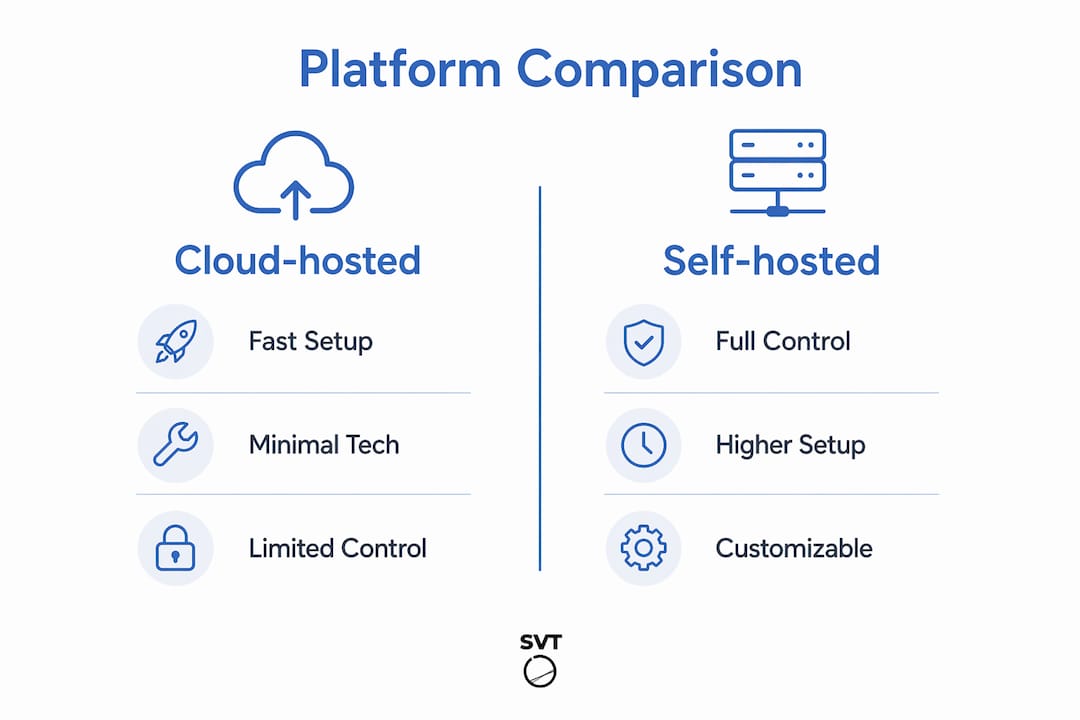
| Feature | Cloud-hosted platforms | Self-hosted solutions |
|---|---|---|
| Setup speed | Fast, minimal technical work | Requires server configuration |
| Data ownership | Provider controls data | You own all data |
| Ongoing cost | Monthly subscription fees | One-time or reduced recurring cost |
| Customization | Template-limited | Full control over design |
| Scalability | Provider-managed | You manage capacity |
Simple Virtual Tour offers both deployment models, which is rare in this category. With over 1,400 active users, the platform supports unlimited tour creation, live session capabilities, e-commerce integration, and an analytics backend. That combination makes it practical for event planners who need to build a large portfolio without paying per-tour fees. You can create unlimited interactive tours and embed them directly on your website, Google Business Profile, or social media channels.
When evaluating any platform, prioritize these features:
- Hotspot interactivity. The ability to embed text, video, links, and forms inside the tour is non-negotiable for a conversion-focused portfolio.
- Mobile optimization. A significant share of venue research happens on mobile devices. Tours that perform poorly on phones lose leads before they start.
- Analytics and heatmaps. You need to know where prospects spend time and where they drop off.
- SEO and AI discoverability. Virtual tours boost organic traffic and generate visibility on AI-powered platforms like ChatGPT when optimized with proper metadata, alt text, and structured data.
For planners who want to understand how virtual tours build client trust before committing to a platform, that context is worth reviewing before you make a technology decision.
Step-by-step guide to producing and promoting your portfolio
Treating your portfolio as a repeatable production system, rather than a one-off creative project, is what separates planners who scale from those who stall. EventsAir's virtual events framework outlines eight phases for consistent execution, and the same logic applies to portfolio production.
- Define your goals and KPIs. Decide what success looks like before you shoot a single frame. Are you targeting a 20% increase in qualified inquiries? A reduction in discovery call length? Set specific numbers so you can measure progress.
- Plan your shoots. Create a shot list for each venue. Stage the space as it would appear during an event, not as an empty room. Lighting, table settings, and branded decor all communicate professionalism. Coordinate with venue managers at least two weeks in advance.
- Shoot in 360 degrees. Use a 360-degree camera to capture equirectangular images for each key area. Shoot from multiple heights to show both the guest perspective and the planner's operational view. Consistency across entries builds portfolio credibility.
- Build the tour with hotspots and CTAs. Upload your images to your chosen platform, add hotspot labels that answer buyer questions, and embed at least one CTA per tour scene. Practical access guides and rehearsals reduce friction for first-time viewers, so consider adding a brief "how to navigate this tour" note at the entry point.
- Embed across digital touchpoints. Place each tour on your website portfolio page, your Google Business Profile, and relevant social media channels. LinkedIn is particularly effective for corporate event planners. Instagram works well for weddings and social events.
- Measure and refine. Review analytics monthly. Identify which tours generate the most CTA clicks and which rooms attract the longest view times. Use that data to prioritize future shoots and improve underperforming entries.
Pro Tip: A 2026 case study of Grand By Jalwa recorded 28,014 tour views in 16 months and a significant increase in wedding package page views, all without paid advertising. Consistent SEO optimization and AI visibility drove that traffic. Apply the same metadata discipline to every tour you publish.
Key takeaways
A virtual tour event planner portfolio converts best when each entry functions as structured commercial evidence, combining immersive 360-degree tours with client context, embedded CTAs, and measurable analytics.
| Point | Details |
|---|---|
| Structure entries as evidence | Include event type, guest count, challenges solved, and outcomes in every portfolio entry. |
| Embed CTAs inside tours | Fixed "Check availability" or "Get a proposal" buttons inside tours capture leads without follow-up emails. |
| Organize by client segment | Group entries by event type so prospects self-qualify and find relevant examples faster. |
| Choose the right platform | Prioritize platforms with hotspot interactivity, analytics, mobile optimization, and flexible hosting options. |
| Treat production as a system | Define goals, plan shoots, build tours, distribute across channels, and measure results on a repeatable cycle. |
Why most event portfolios fail to close clients
Most event planner portfolios I have reviewed share the same flaw: they are built to impress, not to convert. They display beautiful photography, list venue names, and stop there. The prospect is left to do all the mental work of imagining their event, calculating whether the space fits, and figuring out how to take the next step. That friction kills bookings.
The shift I have seen work consistently is treating each portfolio entry as a decision-path asset. You sequence the tour to mirror the questions a prospect asks during a discovery call. You answer capacity questions with hotspot labels. You address logistical concerns in the case study. You make the next step obvious with a persistent CTA. When you do this well, the portfolio does the qualification work for you, and the clients who reach out are already 80% sold.
The other mistake I see frequently is neglecting the corporate segment. Wedding portfolios tend to be visually polished but operationally thin. Corporate decision-makers, particularly procurement managers and executive assistants, need to see proof of execution, not just aesthetics. Adding one well-structured corporate case study with capacity data, AV specs, and a client testimonial can open an entirely different revenue stream.
My recommendation for 2026: audit your existing portfolio against the criteria in this article. If an entry lacks client context, measurable outcomes, and at least one embedded CTA, rebuild it before you add anything new. Quality over quantity is the right standard here.
— Andrea
Build your portfolio faster with Simple Virtual Tour
If you are ready to move from static galleries to a fully interactive event planner showcase, Simple Virtual Tour gives you the tools to do it without a technical team.
Simple Virtual Tour supports unlimited tour creation, so you can build out every venue and event type in your portfolio without per-tour fees eating into your margin. The platform's hotspot editor, embedded CTA tools, and analytics dashboard are designed to be accessible even if you have never worked with 360-degree photography before. The dual cloud-hosted and self-hosted deployment options mean you control your data and your costs. Over 1,400 planners and marketers already use it to showcase venues and engage clients more effectively. Explore the platform and see how quickly your first tour comes together.
FAQ
What is a virtual tour event planner portfolio?
A virtual tour event planner portfolio is a curated collection of immersive 360-degree venue tours combined with professional case studies, client context, and embedded calls to action. It functions as an interactive event portfolio designed to qualify prospects and drive bookings.
How do 360-degree event tours improve client conversions?
360-degree tours allow clients to evaluate venue layouts, capacities, and amenities virtually before committing to a site visit. Invision Studio reports that tours with embedded CTAs produce enhanced conversions, fewer no-shows, and stronger engagement from out-of-market planners.
How often should I update my event planner portfolio?
Update your portfolio at least quarterly by adding new tour entries and retiring outdated ones. Consistent updates signal active practice and maintain the quality standard that attracts your ideal clients.
What should I include in each portfolio entry?
Each entry should include a 360-degree tour, event type, guest count, client brief, challenges solved, measurable outcomes, and at least one embedded CTA. TYPZA's research confirms that entries structured this way attract more qualified leads than photo-only galleries.
Can virtual tour portfolios generate organic traffic without paid ads?
Yes. The Grand By Jalwa case study recorded over 28,000 tour views in 16 months with no paid promotion, driven by SEO optimization and AI platform visibility. Proper metadata, alt text, and structured data are the key factors behind that organic reach.