

Interactive virtual tours are defined as immersive, 360-degree digital walkthroughs that let event clients explore a venue remotely before committing to a site visit or contract. Understanding how virtual tours simplify destination venue sales is now a core competency for event sales and marketing professionals. Venues using comprehensive virtual tours see a 78% increase in sight-unseen bookings and reduce their sales cycles by 43 days on average. That single shift changes how your team spends its time, who fills your pipeline, and how fast deals close. This guide covers the mechanics, the data, and the strategy behind making virtual tours your most productive sales asset.
How virtual tours simplify destination venue sales through trust and engagement
Client trust is the first barrier in destination venue sales. When a corporate event planner in Chicago is evaluating a resort in Scottsdale, a photo gallery does not answer the questions that matter: How does the ballroom flow into the pre-function space? Does the outdoor terrace feel intimate or exposed? Virtual tours answer those questions directly.
Visitors spend 4.5 to 6 times longer exploring virtual tours compared to photo galleries. That extended engagement time is not passive browsing. It reflects a client mentally placing their event inside your space, testing layouts, and building confidence in the booking decision.
Virtual tours provide an unfiltered source of truth that reduces uncertainty and psychological distance in high-ticket event bookings. Traditional photography is curated and selective. A 360-degree walkthrough shows the loading dock, the ceiling height, the natural light at noon. That transparency reduces attendee anxiety and eliminates the guesswork that stalls decisions.
The specific features that drive this trust include:
- 360-degree spherical panoramas that let clients rotate their view and examine every corner of a room
- Embedded floor plan overlays that communicate scale and spatial relationships photos cannot convey
- Ambient audio or narration tracks that reinforce the mood of a rooftop terrace or a historic ballroom
- Hotspot annotations that highlight technical details like ceiling rigging points, AV infrastructure, and power access
Adding virtual tours increases visitor engagement by up to 400%, correlated with 40–95% higher booking conversion rates. That range is wide because placement and integration matter as much as the tour itself.
How do virtual tours reduce the sales cycle and qualify leads faster?

Virtual tours act as a quiet extension of your sales team, reaching global clients across time zones without travel costs or staff time. A prospect in London can tour your Nashville event center at 11 p.m. on a Tuesday. By the time your sales manager opens their inbox the next morning, that prospect has already self-qualified.
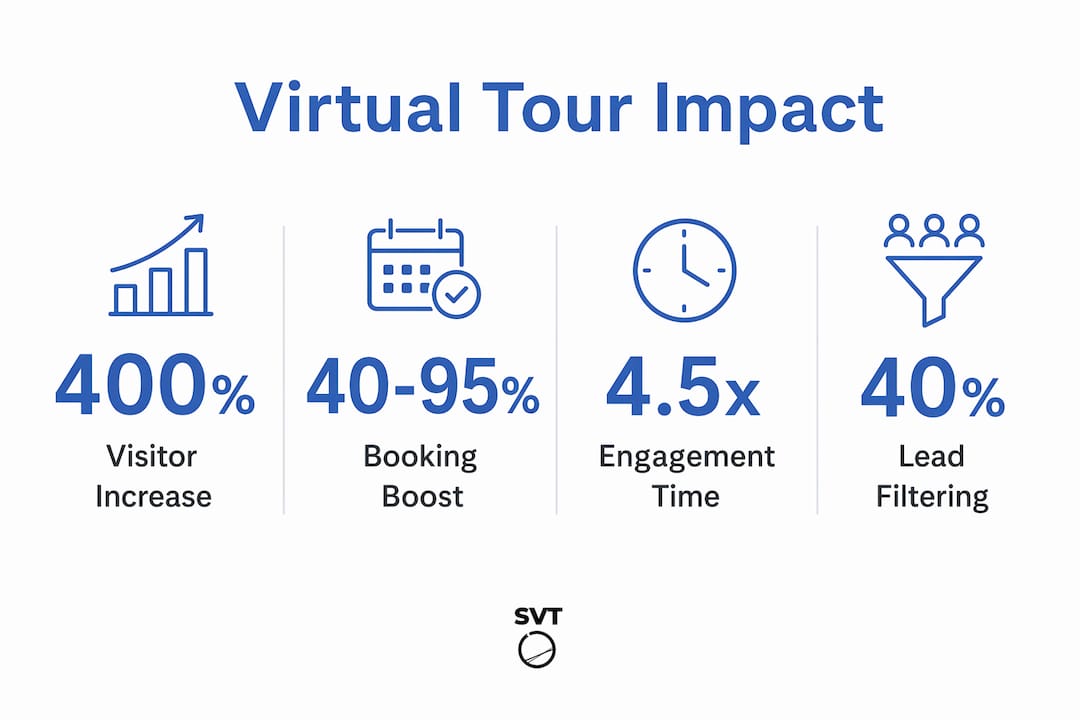
The sales cycle reduction is measurable. Venues using virtual tours book 35–40% faster and handle 165% more inquiries with the same staff. The reason is straightforward: clients arrive at the first conversation already familiar with the space, so the discussion moves directly to pricing, availability, and logistics.
The most effective approach combines virtual tours with a structured pre-qualification workflow:
- Embed the tour on your inquiry page so prospects explore the space before submitting a contact form.
- Attach a pre-qualification form immediately after the tour, asking for event date, guest count, and budget range.
- Filter responses automatically using your CRM to flag high-intent leads based on form answers.
- Trigger a follow-up within 48 hours for qualified prospects. Structured 48-hour follow-ups increase conversion rates by 30% on qualified leads.
- Reserve in-person site visits for prospects who have already seen the tour and confirmed budget alignment.
Pre-qualification forms integrated with virtual tours filter out 40% of irrelevant leads and increase high-intent prospect conversion by 30%. Sales qualification time drops by 20%. Those numbers represent real hours your team reclaims each week.
Showing practical details like fire exits, rigging points, and service corridors inside the tour filters out unsuitable inquiries early. A client whose event requires a flat floor will self-select out when they see the tiered seating configuration. That saves your team a site visit and a polite rejection call.
Pro Tip: Place your virtual tour link in your email signature and in every inquiry auto-response. Prospects who explore the tour before your first call convert at a significantly higher rate than cold contacts.
What features and integrations maximize virtual tour effectiveness?
A virtual tour that lives in a gallery tab converts poorly. The strongest conversion lifts of 8–12% occur when tours are positioned as booking engines next to room pages, not buried in media galleries. Placement is a strategic decision, not a design afterthought.
The features that separate high-converting tours from passive visual content are specific and measurable. Conversion lift depends on treating tours as functional booking tools with embedded calls to action rather than passive visual content. A tour without a "Check Availability" button is a missed opportunity at the moment of peak client interest.
Key integration points for event venue sales teams include:
- Embedded booking links placed inside the tour at high-interest moments, such as the main ballroom view or the outdoor ceremony space
- Google Business Profile integration so prospects touring your venue on Google Maps experience the same immersive walkthrough
- CRM tagging that records which tour sections a prospect viewed, giving your sales team conversation starters
- Analytics dashboards that show which rooms generate the most engagement and which exit points signal hesitation
Simple Virtual Tour supports e-commerce integration within tours, allowing venues to embed add-on packages, catering menus, or room upgrades directly inside the walkthrough. That turns a passive tour into a revenue-generating touchpoint before the first sales call.
For venues managing multiple event spaces, the ability to create unlimited tours without per-tour fees changes the economics of the decision. A venue with a ballroom, a rooftop terrace, and three breakout rooms can maintain a dedicated tour for each space and link them together in a single client-facing experience.
How do virtual tours compare to traditional marketing tools for venue bookings?
The comparison between virtual tours and traditional marketing tools is not close in the metrics that matter most to sales teams.
| Marketing Tool | Avg. Client Engagement Time | Lead Qualification Impact | Booking Speed |
|---|---|---|---|
| Static photo gallery | Low (under 1 minute) | Minimal filtering | Standard sales cycle |
| Video walkthrough | Moderate (2–3 minutes) | Some filtering | Moderate improvement |
| In-person site visit | High (1–2 hours) | Strong but costly | Fastest close rate |
| Interactive virtual tour | Very high (4.5–6x photos) | Strong remote filtering | 35–40% faster bookings |
The in-person site visit still closes deals fastest once a prospect arrives. The problem is the cost and time required to get them there. Virtual tours replicate most of the qualification value of a site visit at a fraction of the cost, and they do it at scale across hundreds of prospects simultaneously.
"Virtual tours act as a 'quiet extension' of the sales team, reaching global clients remotely without costly site visits and enabling continuous venue presence across time zones." — Venue View Expert Insights
The role of virtual tours in the event sales process is not to replace the human relationship. It is to ensure that the human relationship starts at a higher level of mutual qualification. Your sales manager's time is worth more spent closing a pre-qualified prospect than educating a cold lead about ceiling heights and parking capacity.
For event planners building a virtual tour portfolio, the ROI argument is straightforward: one well-produced tour serves thousands of prospects over its lifetime, while a single in-person site visit serves one.
Key Takeaways
Virtual tours are the most efficient lead qualification and conversion tool available to destination venue sales teams, combining immersive visualization with measurable booking speed improvements.
| Point | Details |
|---|---|
| Trust drives conversion | Virtual tours reduce client uncertainty by showing accurate, unfiltered space details that photos cannot replicate. |
| Sales cycles shrink measurably | Venues using virtual tours book 35–40% faster and handle 165% more inquiries with the same staff. |
| Placement determines ROI | Tours positioned next to room pages as booking tools generate 8–12% higher conversion than tours buried in galleries. |
| Pre-qualification multiplies results | Pairing tours with intake forms filters 40% of irrelevant leads and raises high-intent conversion by 30%. |
| Follow-up speed is non-negotiable | Structured 48-hour follow-ups on qualified leads increase conversion rates by 30%. |
What I've learned about virtual tours that most venues still get wrong
After watching venue sales teams adopt virtual tours across hospitality, event spaces, and destination resorts, the pattern I see most often is this: venues invest in a beautiful tour and then treat it like a brochure. They post it in a gallery, share it occasionally on social media, and wonder why bookings did not change.
The venues that see real results treat the tour as the first step in a structured sales funnel. The tour qualifies. The form captures intent. The follow-up closes. Without all three, the tour is just expensive content.
Buyer expectations in event planning have shifted faster than most venue marketing teams realize. Corporate event planners, especially those managing multi-city programs, now expect to evaluate spaces remotely before committing to a site visit. If your venue cannot support that expectation, the shortlist conversation may never happen.
The technology is genuinely accessible now. Platforms like Simple Virtual Tour make it possible to create and publish unlimited tours without technical expertise, which removes the production barrier that once made this a large-venue-only advantage. The remaining barrier is strategic, not technical. Venues that integrate tours into their full sales workflow, including live session capabilities for real-time client walkthroughs, will outperform those that treat tours as a one-time marketing asset.
My honest advice: audit where your tour currently lives on your website. If a prospect cannot find it within two clicks of your homepage, you are losing qualified leads before the conversation starts.
— Andrea
Start creating venue tours that actually close deals
Event sales teams that want to move faster and qualify better need tools that work without a steep learning curve.
Simple Virtual Tour gives venue marketing professionals the ability to build unlimited interactive tours with embedded booking links, e-commerce integration, and live session capabilities. Over 1,400 users rely on the platform for both cloud-hosted and self-hosted deployments, giving venues full control over their data and presentation. The intuitive backend means your team can publish a new tour for a refreshed event space in hours, not weeks. If you are ready to turn your venue's digital presence into a qualified lead engine, Simple Virtual Tour is built for exactly that workflow.
FAQ
What is a virtual tour in the context of venue sales?
A virtual tour is an interactive, 360-degree digital walkthrough of a venue that clients explore remotely before booking. It replicates the spatial experience of an in-person visit and is used to qualify leads, build trust, and accelerate the sales cycle.
How do virtual tours increase direct bookings for event venues?
Virtual tours increase direct bookings by giving clients the confidence to commit without an in-person visit. Venues using them see 35–40% faster booking rates and up to 95% higher conversion compared to photo-only presentations.
Why do venue virtual tours improve client trust more than photos?
Virtual tours show unfiltered, accurate representations of a space, including logistical details like ceiling heights, service access, and room flow. That transparency reduces uncertainty and gives clients the confidence to make high-ticket booking decisions remotely.
Where should a venue place its virtual tour for maximum conversions?
Tours placed directly next to room or event space pages, functioning as booking tools with embedded calls to action, generate 8–12% higher conversion rates than tours placed in media galleries or secondary pages.
Can virtual tours replace in-person site visits entirely?
Virtual tours reduce the need for early-stage site visits by qualifying prospects remotely, but in-person visits still close deals fastest for high-value bookings. The most effective model uses virtual tours to pre-qualify and reserve in-person visits for serious, budget-confirmed prospects.