

Storefront virtual tours are immersive, interactive digital experiences that let customers explore your physical store online, in full 360 degrees, before they ever set foot inside. The storefront virtual tour benefits are measurable and immediate: businesses that deploy them see up to 300% more online engagement compared to those using only static images. Tools like Simple Virtual Tour and Matterport make it possible for any retailer, boutique, or showroom to publish a professional tour without technical expertise. This article breaks down the seven most impactful advantages, backed by 2026 data, so you can decide exactly where virtual tours fit your growth strategy.
1. What are the primary storefront virtual tour benefits?
The core advantage of a 360-degree virtual tour is that it replaces passive browsing with active exploration. Customers click, rotate, and move through your space on their own terms. That sense of control drives deeper engagement than any photo gallery or promotional video can deliver.
The numbers support this directly. Virtual tours triple the average time a visitor spends on your website. Longer sessions signal relevance to Google's search algorithm, which improves your organic ranking over time. For retailers competing in crowded local markets, that SEO lift alone justifies the investment.

Conversion rates follow the same pattern. Users who engage with a high-quality virtual tour are up to 67% more likely to proceed to a booking or purchase compared to users who skip the tour entirely. That gap is not marginal. It represents the difference between a browser and a buyer.
The sectors gaining the most right now include furniture showrooms, boutique apparel, hospitality venues, and specialty food retailers. Each of these depends on ambiance and spatial context to close a sale. A virtual tour delivers both.
Pro Tip: Embed your virtual tour above the fold on your homepage or store locator page, not buried in a gallery tab. Placement determines whether customers actually engage with it.
2. How do virtual tours compare to photos and videos?
Photos and videos are passive. A customer looks at what you choose to show them, in the order you decide. A virtual tour hands control to the visitor. That shift from passive to active is the single biggest reason virtual tours outperform traditional visual media on every engagement metric.
Here is a direct comparison across the three formats:
| Feature | Photos | Videos | Virtual Tours |
|---|---|---|---|
| User control | None | None | Full |
| Repeat visit value | Low | Low | High |
| Update cost | Low | High (reshoot) | Low (modular) |
| Behavior analytics | None | Basic | Granular |
| Conversion signal | Weak | Moderate | Strong |
The analytics advantage deserves attention. Virtual tours generate granular data on where visitors linger, which products they inspect, and where they exit. Photos and videos cannot produce that level of insight. You can use that data to adjust product placement, update hotspots, and refine your merchandising strategy without guessing.
Videos also age quickly. A promotional video shot in 2024 looks dated by 2026 if your store layout has changed. A virtual tour built on modular software like Simple Virtual Tour lets you update individual hotspots and sections without a full reshoot. That keeps your content current at a fraction of the ongoing cost.
3. Operational advantages that most retailers overlook
The most underappreciated virtual storefront advantage is what happens behind the scenes. A virtual tour functions as an always-on sales asset that works around the clock without staff involvement. That changes your cost structure in a meaningful way.
Physical showrooms require rent, staff, utilities, and regular display refreshes. A virtual showroom removes those geographic and overhead constraints entirely. International customers can explore your store at 2 a.m. in their time zone with zero additional cost to you. That reach is simply not possible with a physical location alone.
The modular update model also matters operationally. Successful virtual tours are built so you can change hotspots, swap product images, and revise floor layouts without rebuilding the entire tour. This means your virtual tour becomes evergreen marketing content rather than a one-time production expense.
Here is where the operational benefits concentrate:
- Analytics: Track which sections of your store attract the most attention and use that data to inform real-world merchandising decisions.
- Multi-channel deployment: Publish the same tour on your website, Google Business Profile, social media campaigns, and email newsletters without creating separate assets.
- Sales meeting support: Share a tour link during a video call or sales consultation to orient remote clients before they visit in person.
- Scalability: Add new locations or seasonal displays to your tour library without proportional increases in production cost.
Pro Tip: Connect your virtual tour analytics to Google Analytics 4 by embedding the tour with UTM parameters. You will see exactly which traffic sources drive the most tour engagement, and you can allocate your ad budget accordingly.
4. How virtual tours improve customer trust and reduce sales friction
Uncertainty is the primary reason customers abandon a purchase. They are not sure the store matches their expectations, the product looks different in person, or the layout is confusing. Removing that uncertainty is the primary driver of ROI in virtual tours.
A well-built tour shows the exact store layout, lighting, product placement, and ambiance. Customers arrive already oriented. They know where to go, what to expect, and what they want to see. That experiential confidence translates directly into shorter sales cycles and fewer cancellations.
The hospitality sector has documented this effect clearly. Properties using professional virtual tours see conversion rates increase by 135% on average, and cancellations drop by 34%. Restaurants using virtual tours report a 28% reduction in no-shows. The mechanism is the same across sectors: when customers can inspect a space digitally before committing, they commit with more confidence.
For high-ticket retail, the trust benefit extends to post-purchase behavior. Experiential confidence gained from a virtual tour reduces return rates and change orders because customers make more informed decisions upfront. A furniture showroom, for example, can let a customer virtually walk through a fully staged room before ordering a custom piece.
"Customers who toured our showroom virtually before visiting in person arrived ready to buy. They had already made their decision. We just had to confirm the details."
This pattern repeats across retail categories where spatial context matters. The virtual tour builds trust before the first in-person interaction even happens.
5. Google Business Profile visibility and local SEO impact
Google Business Profiles with virtual tours receive significantly more views and clicks than profiles without them. That is not a minor difference in ranking signals. It directly affects how often your business appears in local search results and the Google Maps 3-pack.
Google Business Profiles with virtual tours show up more frequently in local discovery searches. More views translate to more clicks, more calls, and more foot traffic. For any retailer relying on local customers, this is one of the highest-return SEO actions available.
The mechanism works because Google rewards content that keeps users engaged. A virtual tour embedded in your profile increases the time users spend interacting with your listing. That behavioral signal tells Google your business is relevant and worth surfacing. Pair that with the longer on-site sessions your website tour generates, and you build a compounding SEO advantage over competitors who rely only on photos.
6. Which storefront tour features maximize your results?
Not all virtual tours deliver the same return. The features you activate and how you integrate the tour into your customer journey determine whether it becomes a high-performing asset or a neglected page element.
The features that consistently drive the best results include:
- Interactive hotspots with click-to-buy or booking links: Adding click-to-buy hotspots within the tour environment enables direct purchases without requiring the customer to navigate away. This shortens the path from interest to transaction.
- Mobile optimization: More than half of all web traffic comes from mobile devices. A tour that performs poorly on a smartphone loses a significant portion of your audience. Mobile-optimized tours increase accessibility for on-the-go shoppers who are often in a high-intent browsing state.
- Live guided session capability: Pairing a self-guided tour with a live guided option lets your sales team walk remote clients through the space in real time. This works especially well for wholesale buyers, interior designers, or event planners evaluating your venue.
- Strategic embedding: Integrating the tour into your store locator page, product landing pages, and sales meeting decks multiplies its impact. A tour buried in a gallery tab performs far below its potential.
- Regular content updates: Treat your tour as a living asset. Update hotspots when products change, add seasonal displays, and refresh featured items to keep the experience current.
The biggest mistake retailers make is treating a virtual tour as a one-time production. Its value compounds when you update it regularly and embed it throughout the customer journey.
7. Reaching international customers with zero added overhead
A virtual tour removes the geographic ceiling on your customer base. A boutique in Austin can attract buyers from London, Tokyo, or São Paulo without opening a second location. Virtual showrooms serve customers beyond geographic limits 24 hours a day, 7 days a week, with no recurring physical store costs.
This matters most for retailers with distinctive products, strong brand identity, or niche appeal. If your store offers something customers cannot find locally, a virtual tour gives them the confidence to order from a distance. They can inspect the space, understand the brand experience, and evaluate product context before committing to a purchase or a trip.
The cost comparison is stark. Maintaining a second physical location requires lease commitments, staffing, inventory, and ongoing overhead. A virtual tour requires a one-time production investment and periodic updates. For most independent retailers, the virtual option delivers international reach at a fraction of the cost.
Key takeaways
Storefront virtual tours deliver measurable gains in engagement, trust, and conversions by giving customers active control over how they explore your space.
| Point | Details |
|---|---|
| Engagement multiplier | Virtual tours triple average time on site, strengthening Google search rankings. |
| Conversion lift | Users who engage with a tour are up to 67% more likely to purchase or book. |
| Trust and friction reduction | Showing exact layout and ambiance eliminates uncertainty and reduces cancellations. |
| Operational efficiency | Modular updates keep tours current without full reshoots or added production costs. |
| Local SEO advantage | Google Business Profiles with virtual tours earn significantly more views and clicks. |
Why I think most retailers are still leaving this on the table
I have spent years watching businesses invest heavily in paid ads and social content while their physical store, their single strongest differentiator, stays invisible online. A well-shot photo gallery is not the same thing. It does not let a customer feel the scale of your showroom, understand how your products are arranged, or sense the atmosphere that makes your brand worth visiting.
What surprises me most is how few independent retailers have adopted virtual tours despite the clear data. The technology is accessible, the production cost is manageable, and the tools available today, including Simple Virtual Tour, require no technical background to operate. The barrier is not capability. It is awareness.
The retailers I have seen get the most from virtual tours treat them as a core part of their digital presence, not a novelty. They embed tours on their homepage, share them in sales conversations, update them seasonally, and track the analytics. That discipline is what separates a tour that drives revenue from one that sits unused.
My honest advice: start with one well-built tour of your primary location. Measure the engagement, watch the conversion data, and let the results guide your next step. You do not need a perfect strategy before you begin. You need a starting point.
— Andrea
Build your storefront virtual tour with Simple Virtual Tour
If you are ready to put these advantages to work, Simple Virtual Tour gives you everything you need to create and manage professional storefront tours without a technical team.
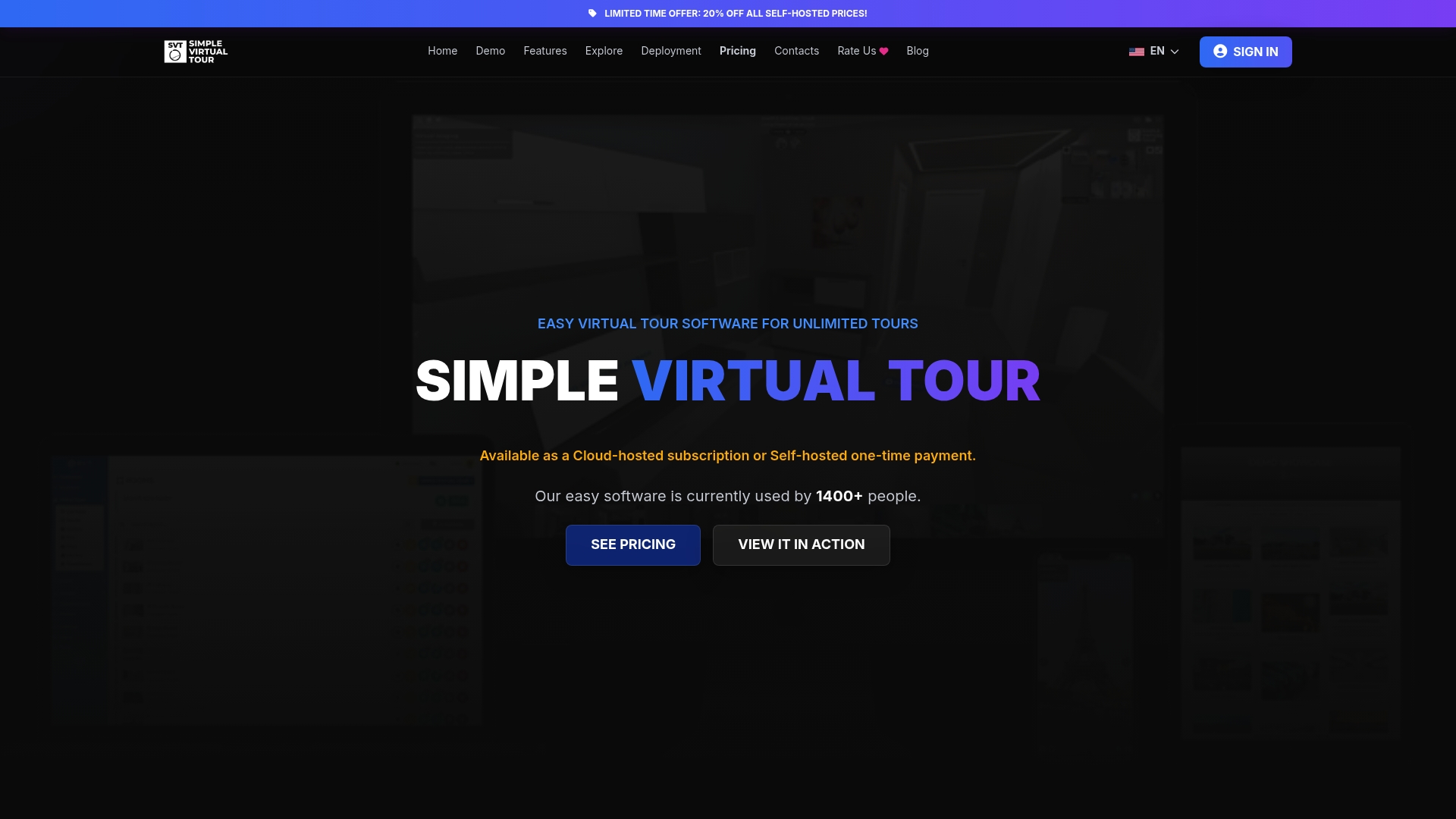
The platform supports unlimited tour creation, modular updates, live session capabilities, and direct e-commerce integration so your tour can drive purchases, not just views. With over 1,400 active users and both cloud-hosted and self-hosted deployment options, Simple Virtual Tour gives you full control over your data and your costs. You can embed tours on your website, connect them to your Google Business Profile, and optimize them for mobile visitors from day one. Explore the platform and get started today to turn your physical storefront into an always-on digital asset.
FAQ
What are the main benefits of a storefront virtual tour?
Storefront virtual tours increase website engagement, improve Google Business Profile visibility, build customer trust, and raise conversion rates. Users who interact with a virtual tour are up to 67% more likely to purchase compared to those who do not.
How do virtual tours improve sales for retailers?
Virtual tours reduce purchase uncertainty by showing customers the exact store layout, product placement, and ambiance before they visit. This experiential confidence shortens sales cycles and reduces cancellations and returns.
Do virtual tours help with local SEO?
Google Business Profiles with virtual tours receive significantly more views and clicks than profiles without them, improving local search rankings and increasing foot traffic to physical locations.
How often should I update my storefront virtual tour?
Update your tour whenever your store layout, featured products, or seasonal displays change. Modular virtual tour software lets you swap hotspots and sections without a full reshoot, keeping your content current at low cost.
Can small retailers afford a professional virtual tour?
Virtual tour software like Simple Virtual Tour is designed for businesses without large technical or production budgets. The one-time creation cost is significantly lower than maintaining a second physical location, and the tour functions as an evergreen marketing asset across multiple channels.