

Virtual tours are defined as interactive, 360° digital experiences that let potential customers explore a physical business space remotely before ever stepping through the door. The role of virtual tours in local business discovery goes far beyond a visual upgrade. They act as trust signals, engagement drivers, and local SEO boosters all at once. Businesses with 360° virtual tours see 10 times more engagement than those without. Customers who interact with a virtual tour are 16% to 67% more likely to make a booking or purchase. For local business owners, that is not a marginal gain. It is a measurable shift in how customers find, trust, and choose you.
How virtual tours improve local business discovery and search rankings
Google's local search algorithm rewards engagement. When a potential customer lands on your Google Business Profile and spends time exploring a virtual tour, that behavior sends a positive signal to the algorithm. Time on page tripled on listings with 360° virtual tours compared to listings without them. That single metric tells Google your profile is worth showing to more people.
The difference between a photo gallery and a virtual tour is not just visual quality. It is the depth of interaction. A static photo takes two seconds to scan. A virtual tour keeps a visitor engaged for minutes. Google's algorithm treats that extended interaction as proof that your listing is relevant and trustworthy.

Listings with virtual tours also generate more clicks, direction requests, and phone calls compared to listings without them. Each of those actions is an engagement signal that feeds back into your local ranking. The cumulative effect is a listing that climbs higher in local search results over time.
Key engagement signals that virtual tours strengthen:
- Time on listing: Visitors explore rather than bounce, signaling relevance to Google.
- Direction requests: Customers who pre-qualify your space virtually are more likely to visit physically.
- Click-through rate: Rich visual content draws more clicks from search results pages.
- Phone calls: Customers who have already toured your space call with intent, not just curiosity.
For a deeper look at how 360° tours influence local SEO metrics, the 360 tour local attraction promotion guide covers ranking factors in detail.
What types of virtual tours work best for local discovery?
Two main formats serve local businesses: Google Street View compatible tours and custom interactive tours. Each has a distinct role, and choosing the wrong one for your goal costs you visibility.
Google Street View tours publish directly to Google Maps and your Google Business Profile. They integrate natively into local search results, meaning customers see your tour without leaving Google. Simple 360° Google Street View tours often outperform richer 3D tours for local discovery because they remove the extra click required to reach an external platform. Google also hosts these tours free forever when published to your Business Profile, which eliminates recurring hosting costs.
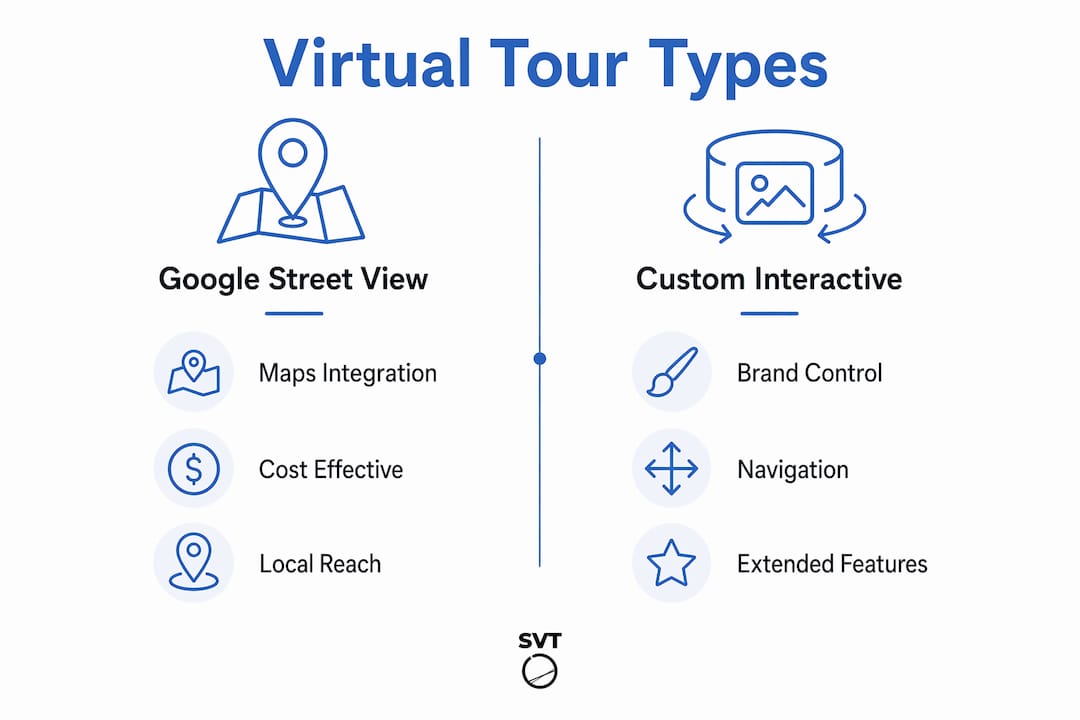
Custom interactive tours built with platforms like Simple Virtual Tour offer more control over branding, navigation, and lead capture. You can embed them on your website, add hotspots, include product information, and connect them to e-commerce functions. These tours excel at converting website visitors who have already found you. They are less effective as a first discovery tool unless you actively promote them.
| Format | Best for | Cost model | Discovery strength |
|---|---|---|---|
| Google Street View tour | First-touch local discovery | Free hosting via Google | High (native search integration) |
| Custom interactive tour | Website conversion and branding | Software or hosting fee | Medium (requires promotion) |
Pro Tip: Align your tour format with your primary goal. If you want more people to find you in Google Maps, start with a Street View tour. If you want website visitors to convert, add a custom interactive tour to your site's About or Contact page.
Professional virtual tour photography for small and medium local businesses typically costs between $450 and $700 USD, with capture and publishing taking less than one hour when you are well prepared. That is a low time investment for an asset that works around the clock.
How to implement and promote virtual tours for maximum local reach
Getting a virtual tour live is only half the work. Active promotion determines whether it generates real discovery or sits unnoticed.
-
Capture your space. Use a 360° camera or hire a certified photographer. Prepare your space in advance: clean, well lit, and representative of your best customer experience. Capture time is typically under one hour for most retail or service spaces.
-
Publish to your Google Business Profile. Upload your Street View tour directly through the Google Maps app or via a certified Street View photographer. This makes the tour visible in Google Maps and local search results immediately.
-
Embed the tour on your website. Place it on your About page, Contact page, or a dedicated virtual tour page. Website features that convert consistently include rich media like virtual tours because they reduce visitor hesitation and increase time on site.
-
Promote through social media. Share your tour link on Facebook, Instagram, and any local community groups. A short video clip of the tour walkthrough performs well as a social post and drives traffic back to your full tour.
-
Link your tour in GBP updates. Google Business Profile posts that include a link to your virtual tour send fresh content signals to the algorithm. Embedding tours in GBP updates periodically reinforces your ranking over time.
-
Update your tour seasonally. A tour that reflects your current space signals freshness to search engines. If you redecorate, expand, or change your layout, update the tour. Stale content weakens the signal.
Pro Tip: Add your virtual tour link to your email signature and any local directory listings you maintain. Every additional entry point increases the chance a new customer finds and explores your space.
Set-and-forget virtual tours deliver lower ROI than tours that are actively integrated into your marketing. Treat your tour as a living asset, not a one-time upload.
How to measure the impact of virtual tours on customer engagement
Tracking performance tells you whether your tour is working and where to improve. Google Business Profile Insights provides the clearest starting point for local businesses.
Watch these key performance indicators after publishing your tour:
- Profile views: Are more people finding your listing after the tour went live?
- Direction requests: An increase here shows the tour is converting digital browsers into physical visitors.
- Phone calls from listing: Customers who call after viewing a tour tend to be further along in their decision.
- Website clicks: A rise in clicks from your GBP to your website suggests the tour is building enough interest to prompt further research.
Virtual tours reduce unnecessary physical viewings by about 40% by helping customers pre-qualify a space digitally. That means the customers who do visit are more likely to convert. Fewer tire-kickers, more buyers.
For custom interactive tours embedded on your website, Google Analytics 4 tracks time on page, scroll depth, and conversion events. Set up an event trigger for tour interactions so you can see exactly how many visitors engage with the tour versus those who skip it. Pair that data with your booking or inquiry numbers to calculate a direct conversion lift.
Review your metrics monthly for the first three months after launch. Look for trends rather than single-day spikes. A steady rise in direction requests over six weeks is a stronger signal than a one-day traffic bump. Use that data to decide whether to update the tour, promote it more actively, or add a second tour for a different area of your business.
Key takeaways
Virtual tours are the most cost-effective trust signal a local business can add to its Google Business Profile and website in 2026.
| Point | Details |
|---|---|
| Engagement drives ranking | Virtual tours triple time on listing, sending strong signals to Google's local algorithm. |
| Format choice matters | Google Street View tours win for discovery; custom interactive tours win for website conversion. |
| Active promotion multiplies ROI | Linking tours in GBP updates, social posts, and website pages compounds their SEO benefit. |
| Measure monthly | Track direction requests, calls, and profile views to confirm the tour is converting browsers into visitors. |
| Low cost, high return | Professional capture costs $450–$700 and takes under one hour, with free hosting via Google. |
Why I think most local businesses are leaving this opportunity on the table
Most local business owners I speak with assume virtual tours are expensive, technically complex, or only relevant for large venues like hotels or event spaces. That assumption is costing them real customers.
The truth is that a well-placed Google Street View tour costs less than a single print ad run and works every day of the year. The businesses that benefit most are not the ones with the fanciest tours. They are the ones that published a clean, accurate tour and then actively promoted it. A dentist's office that embeds a tour on its booking page sees fewer appointment cancellations because patients already know what to expect. A boutique retailer that shares its tour in a local Facebook group gets foot traffic from people who would never have searched for it directly.
The biggest mistake I see is treating a virtual tour as a passive listing feature. You publish it, you move on, and you wonder why nothing changed. The businesses that win with virtual tours treat them the same way they treat any other marketing asset: they update them, link to them, and track what they produce.
The second mistake is over-investing in a high-end 3D tour before testing whether a simpler Street View tour moves the needle. Start with the format that integrates natively into Google. Measure the results. Then decide whether a custom interactive tour adds enough conversion value to justify the additional cost.
Virtual tours are not a future trend. They are a present-day expectation for any local business that wants to compete for digital-first customers.
— Andrea
Simple Virtual Tour makes it easy to get started
Local businesses that want full control over their virtual tour experience without recurring hosting fees have a clear option in Simple Virtual Tour. The platform lets you create unlimited interactive virtual tours with an intuitive backend that requires no technical expertise.
Simple Virtual Tour supports both cloud-hosted and self-hosted deployments, giving you ownership of your data and reducing long-term costs. You can embed tours directly on your website, integrate them with your Google Business Profile, and add features like hotspots and e-commerce links. Over 1,400 businesses already use the platform to create tours that work as always-on digital storefronts. If you are ready to put a virtual tour to work for your local business, Simple Virtual Tour is built to get you there without a steep learning curve.
FAQ
What is the role of virtual tours in local business discovery?
Virtual tours act as interactive digital storefronts that increase engagement on Google Business Profiles, improve local search rankings, and help potential customers pre-qualify a business before visiting in person.
Do virtual tours improve Google local search rankings?
Yes. Listings with virtual tours generate more time on page, direction requests, and clicks, all of which are engagement signals that Google's local algorithm uses to determine ranking.
How much does a virtual tour cost for a small business?
Professional virtual tour photography for small and medium businesses typically costs between $450 and $700 USD, with capture taking under one hour. Google hosts Street View tours free of charge permanently.
Which type of virtual tour is best for local discovery?
Google Street View tours integrated directly into Google Maps provide the strongest local discovery advantage because they appear natively in search results without requiring an extra click to an external site.
How do I measure whether my virtual tour is working?
Track Google Business Profile Insights for changes in profile views, direction requests, phone calls, and website clicks after publishing your tour. Review these metrics monthly for the first three months to identify trends.