

360 tour local attraction promotion is the practice of using interactive, spherical panoramic experiences to market destinations, venues, and local businesses to potential visitors before they arrive in person. Center Parcs recorded a 56.8% conversion increase and 311% longer session duration after integrating virtual tours into their digital presence. That is not a marginal improvement. It is a structural shift in how attractions convert online interest into real visits. This guide is written for tourism marketers and local business owners who want to build that same advantage using 360-degree local experiences, from choosing the right tools to publishing on Google Business Profile and measuring what actually works.
What tools do you need for 360 tour local attraction promotion?
Effective 360 tour local attraction promotion starts with the right hardware and software combination. The hardware decision comes first. Entry-level 360 cameras like the Ricoh Theta series and Insta360 X4 capture equirectangular images suitable for most local attraction tours. For higher-resolution output, the Kandao Qoocam 8K or a DSLR rig with fisheye lenses produces sharper spherical panoramas, though the workflow is more complex.
On the software side, your choice determines how much control you retain over your data and ongoing costs. Platforms like Simple Virtual Tour offer a dual deployment model, meaning you can choose between cloud-hosted and self-hosted solutions. Self-hosted deployment eliminates recurring hosting fees and keeps your data on your own infrastructure. That distinction matters for local businesses managing tight margins. You can compare the trade-offs in detail through this self-hosted vs cloud breakdown.
Google Business Profile (GBP) integration is non-negotiable for local discovery. Google Street View tours on GBP function as the digital front door of your attraction and are permanently hosted at no ongoing cost. That makes GBP the highest-ROI publishing destination for any local attraction tour.
Comparing tools, costs, and best use cases
| Tool | Estimated cost | Best use case |
|---|---|---|
| Google Street View via GBP | From $100 for 5 viewpoints | Small businesses, budget-conscious local listings |
| Simple Virtual Tour (cloud) | Subscription-based, no per-tour fee | Tourism operators needing unlimited tours with e-commerce |
| Simple Virtual Tour (self-hosted) | One-time license | Agencies and operators wanting full data control |
| Matterport | ~$750+ per scan plus ~$20/month hosting | Large venues needing photorealistic 3D digital twins |
| Ricoh Theta Z1 camera | ~$1,000 hardware | Mid-range capture for most attraction types |
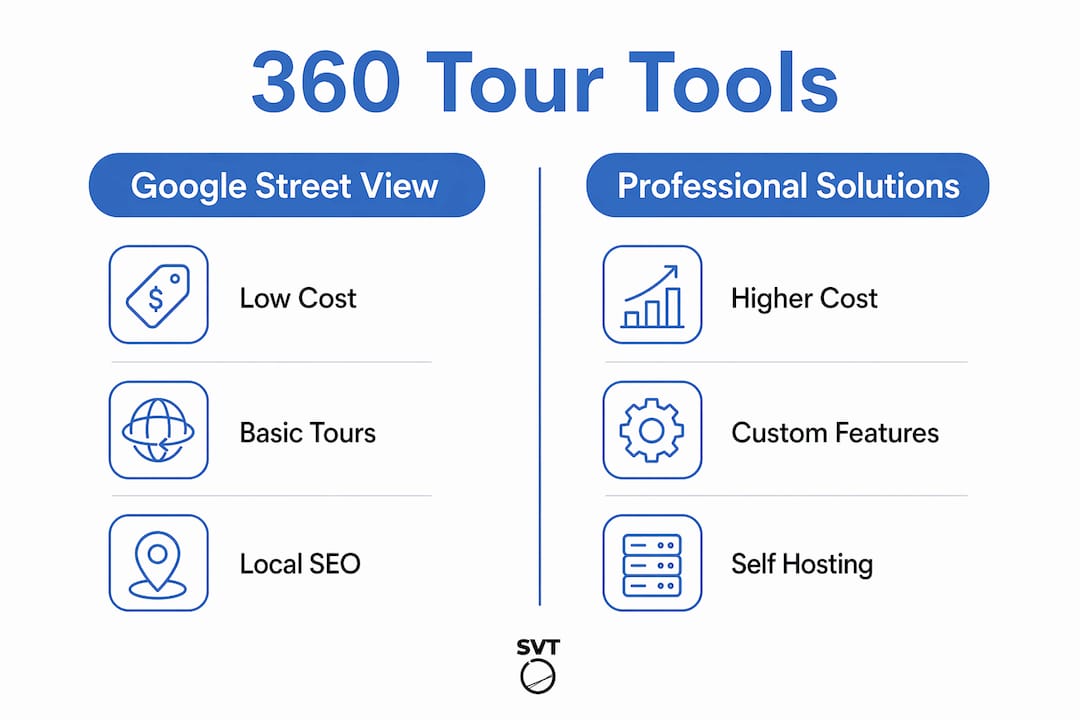
Pro Tip: If you are managing tours for multiple local attractions, a self-hosted solution eliminates per-tour or per-month hosting fees that compound quickly across a portfolio. Simple Virtual Tour's unlimited tour model is specifically designed for this scenario.
How to create and publish a 360 virtual tour step by step
A well-produced interactive attraction promotion follows a repeatable six-step workflow. Skipping steps, particularly planning and mobile optimization, is the most common reason tours underperform.
-
Plan your tour route and content highlights. Walk the attraction before shooting. Identify the five to eight viewpoints that communicate the most value to a first-time visitor. A botanical garden, for example, should prioritize the entrance, signature planting beds, and any indoor conservatory spaces. Planning prevents redundant captures and reduces editing time.
-
Capture high-quality 360° photos. Shoot in RAW format where your camera supports it. Use a tripod with a nadir cap to eliminate the camera's shadow from the floor shot. Overcast days produce the most even lighting for outdoor attractions. Avoid shooting directly into strong light sources, which create blown-out patches in the equirectangular image.
-
Stitch and edit the panoramas. Most modern 360 cameras handle stitching automatically in their companion apps. For manual workflows, PTGui is the industry standard for precision stitching. Adjust exposure, white balance, and horizon alignment before importing into your tour software.
-
Add interactive elements: hotspots, CTAs, and annotations. This step separates a passive slideshow from a genuine interactive attraction promotion. Hotspots link viewpoints together. Annotations provide context, such as the name of a heritage building or the depth of a dive site. CTAs drive commercial action. Tours without embedded CTAs remain digital showcases only, limiting their commercial impact.
-
Publish on your website, Google Business Profile, and social media. Embed the tour on your attraction's main landing page above the fold. Upload a Google Street View-compatible version to GBP. Export short equirectangular preview clips for Instagram Reels and Facebook to drive traffic back to the full experience.
-
Optimize for mobile and accessibility. More than half of local attraction searches happen on mobile devices. Test your tour on iOS Safari and Android Chrome before publishing. Add text descriptions for screen readers and caption hotspot content for accessibility compliance.
Pro Tip: Compress your equirectangular images to under 4MB per panorama before uploading. Larger files cause slow load times on mobile networks, and slow load times are the single biggest driver of tour abandonment.
What are the best strategies for promoting attractions using 360° tours online?
Publishing a tour is not the same as promoting it. Virtual tour marketing requires deliberate distribution across multiple channels to generate the visitor volume that justifies production costs.
The highest-leverage starting point is Google Maps and Google Business Profile. Publishing on GBP increases click-through from local searches because the tour appears directly in the knowledge panel when someone searches for your attraction by name. Visitors who interact with a tour before booking have already built a mental model of the space. That mental familiarity is what shifts visitors from passive browsers to active explorers with genuine booking intent.
Beyond GBP, here are the promotion strategies that generate measurable results:
- Email marketing: Embed a tour thumbnail with a play button in your newsletter. Emails with video or interactive previews consistently outperform static image emails on click-through rate.
- Retargeting campaigns: Use your tour's embed page as a retargeting pixel trigger. Visitors who spend time in the tour but do not book are high-intent prospects. Retarget them on Meta and Google Display with a direct booking offer.
- Social media teasers: Content from a single 360 tour can be reused as social media teasers, GBP photos, and website embeds, preventing repeated shoots and maximizing ROI from one capture session.
- Community-wide initiatives: The Snoqualmie Valley Chamber of Commerce partnered with TrueView360s to create a cohesive regional virtual tour ecosystem for $100 per business. Coordinated regional promotion elevates every participant's visibility, not just the largest attractions.
- Multilingual storytelling: If your attraction draws international visitors, adding multilingual hotspot annotations expands your addressable audience without a separate production budget.
Embedding a booking button or inquiry form directly inside the tour experience is the single highest-impact conversion tactic. Visitors are most engaged at the moment they are exploring your space. That is when the CTA should appear, not after they exit the tour and return to a generic contact page. You can explore how interactive web design elements amplify this effect across the full visitor journey.
How do you measure success and fix common 360 tour issues?
Measuring the performance of your immersive tour advertising requires tracking metrics that go beyond standard page views. Session duration, hotspot interaction rate, and conversion rate uplift are the three numbers that tell you whether your tour is working.
| Metric | Target benchmark | Tracking tool |
|---|---|---|
| Average session duration | 3x baseline page time | Google Analytics 4, Hotjar |
| Hotspot interaction rate | 40%+ of tour visitors | Tour platform analytics |
| Conversion rate uplift | 50%+ vs. non-tour pages | Google Analytics 4 goals |
| Mobile load time | Under 4 seconds | Google PageSpeed Insights |
| GBP tour views | Month-over-month growth | Google Business Profile Insights |
The most common technical issues fall into three categories. Slow loading is almost always caused by uncompressed panorama files or a hosting server without a content delivery network (CDN). Poor image resolution usually traces back to insufficient overlap during capture or aggressive compression during export. Navigation glitches, where hotspots fail to load or the tour freezes mid-session, are typically caused by browser compatibility issues, particularly on older Android WebView versions.
For each of these, the fix is straightforward. Use a CDN-backed host, export at the highest quality your file size budget allows, and test across Chrome, Safari, Firefox, and Samsung Internet before publishing. Local digital marketing audits often surface these technical gaps before they cost you bookings.
Key takeaways
360 tour local attraction promotion works because it combines immersive exploration with embedded conversion triggers, turning passive interest into measurable bookings.
| Point | Details |
|---|---|
| Lead with GBP publishing | Google Business Profile tours increase local search click-through at no ongoing hosting cost. |
| Embed CTAs inside the tour | Booking buttons placed at peak engagement moments convert interest before visitors exit the experience. |
| Reuse assets across channels | One capture session produces social teasers, GBP photos, and website embeds without additional shoots. |
| Track session duration first | A 3x increase in session duration is the clearest early signal that your tour is engaging visitors effectively. |
| Consider self-hosted software | Platforms like Simple Virtual Tour eliminate per-tour fees, making unlimited tour portfolios financially viable. |
Why I think most attractions are still underusing their 360 tours
I have reviewed a lot of virtual tour implementations for local attractions, and the pattern is consistent. The tour gets produced, it gets embedded on the "Visit Us" page, and then it sits there. No GBP integration, no retargeting pixel, no booking CTA inside the experience. The attraction treats it as a one-time content piece rather than marketing infrastructure.
That framing is the core mistake. A well-built 360 tour is a living asset. The same equirectangular images that populate your website tour can feed your GBP listing, your email campaigns, your Instagram previews, and your retargeting audiences. The production cost is fixed. The distribution cost is close to zero. Every additional channel you activate increases the return on that original investment.
The other underused opportunity is community collaboration. Individual attractions promoting themselves in isolation compete for the same local search real estate. When a regional chamber or tourism board coordinates a standardized virtual tour initiative, every participant benefits from the collective digital footprint. The Snoqualmie Valley example is not an outlier. It is a replicable model that most regional tourism bodies have not yet adopted.
The emerging frontier worth watching is live guided virtual tours. The ability to host a real-time guided session inside a 360 environment, where a staff member narrates and responds to visitor questions, adds a human layer that static tours cannot replicate. You can see where this is heading in the role of live virtual guided tours in 2026. Attractions that build this capability now will have a significant head start as visitor expectations shift toward on-demand, interactive pre-visit experiences.
— Andrea
Start building your 360 tour with Simple Virtual Tour
Simple Virtual Tour gives tourism marketers and local businesses everything they need to create, publish, and manage unlimited interactive 360 tours from a single platform.
The software supports both cloud-hosted and self-hosted deployment, so you choose the model that fits your budget and data requirements. Features include live session capabilities, e-commerce integration for in-tour booking, and a backend that requires no technical expertise to operate. Over 1,400 users already rely on it to promote spaces across real estate, tourism, and hospitality. If you are ready to turn your attraction into an interactive experience that converts, get started with Simple Virtual Tour and publish your first tour without a production agency or a large upfront budget.
FAQ
What is 360 tour local attraction promotion?
360 tour local attraction promotion is the use of interactive spherical panoramic experiences to market a venue or destination online, allowing potential visitors to explore the space before visiting in person. It combines immersive visuals with embedded CTAs to drive bookings and increase engagement.
How much does a virtual tour for a local attraction cost?
Costs range from $100 for a basic Google Street View tour with five viewpoints to $750 or more for a professional 3D scan of a larger venue. Hosting fees vary by platform, with Matterport charging around $20 per month and Google Business Profile hosting tours at no ongoing cost.
Does publishing a virtual tour on Google Business Profile improve local SEO?
Yes. Google Street View tours published on Google Business Profile appear directly in local search results and the Google Maps knowledge panel, increasing click-through from people searching for your attraction by name or category.
How do you measure whether a 360 tour is working?
Track session duration, hotspot interaction rate, and conversion rate uplift using Google Analytics 4 and your tour platform's built-in analytics. A session duration three times longer than your baseline page time is a strong indicator of genuine visitor engagement.
Can one 360 tour be reused across multiple marketing channels?
Yes. A single capture session produces assets suitable for website embeds, Google Business Profile photos, social media teasers, and email campaigns, making it one of the most cost-efficient content investments available to local attraction marketers.