

User-generated virtual tour content is media created by unpaid contributors, such as photos, videos, and reviews, embedded directly inside virtual tours to provide authentic, experience-based perspectives that professional content alone cannot replicate. In the industry, this is often called UGC-enriched virtual touring, and it sits at the intersection of user-generated content (UGC) and immersive digital presentation. Across real estate, tourism, and education, this approach is reshaping how audiences engage with virtual spaces. Platforms like Simple Virtual Tour make it practical for professionals to collect and embed this content without technical complexity. Understanding what UGC in virtual tours means, and how to use it well, is one of the most direct ways to increase viewer trust and time-on-tour in 2026.
What is user-generated virtual tour content, exactly?
User-generated virtual tour content is defined as any media created by unpaid contributors and embedded within virtual tour experiences to represent a place from actual visitor perspectives. Common formats include photos, short videos, blog posts, forum entries, and social media messages. The defining characteristic is that the creator has no financial incentive, which is precisely what makes the content feel credible to viewers.
The unpaid nature of UGC is not a limitation. It is the source of its power. Perceived authenticity is the central reason UGC outperforms polished brand media in building viewer confidence. When a prospective apartment renter watches a 30-second clip of a current resident's morning routine filmed in the kitchen, that clip answers questions no professional photographer would think to address.

In practice, UGC-enriched virtual tours layer real visitor or resident contributions on top of the base 360-degree tour. A tourism board might embed traveler photos at specific destination hotspots. A university might attach student video testimonials to a campus building's virtual walkthrough. A real estate agency might pin resident reviews to individual rooms. Each layer converts a visual presentation into a peer-to-peer conversation.
What are the common types of UGC in virtual tours?
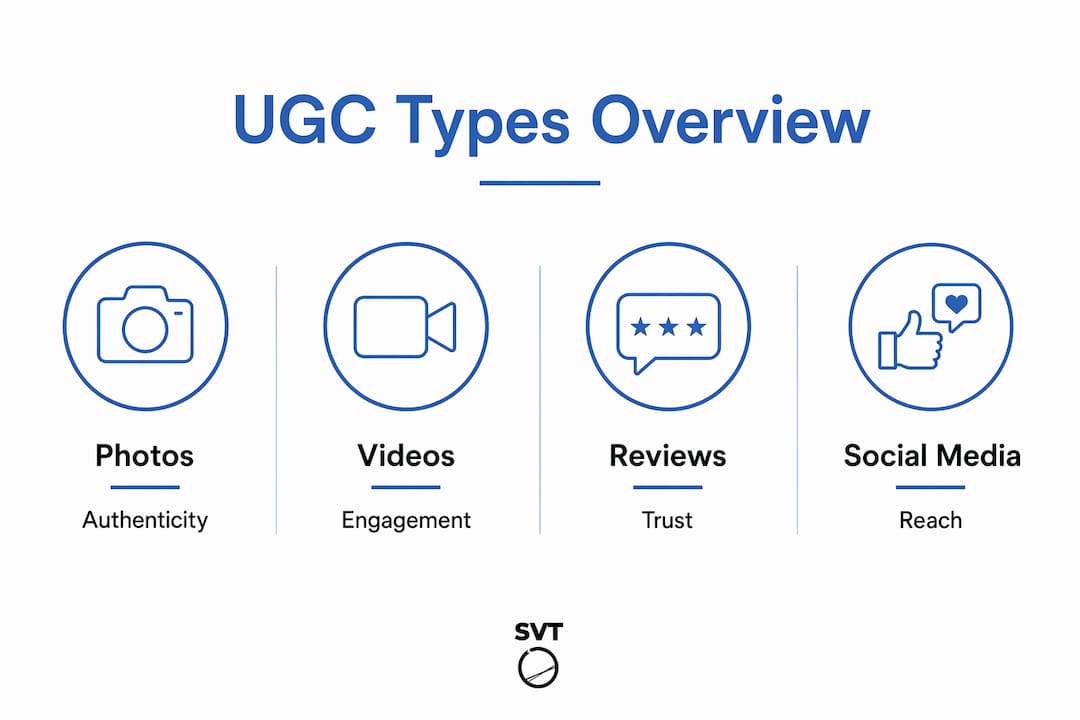
The formats of user-generated content used in virtual tours vary by sector, but they share a common function: they add interpretive context that converts visual content into relatable experiences. Here is how the most common types break down:
- Resident or visitor photos: Still images taken by actual occupants or guests, showing spaces in lived-in conditions rather than staged setups.
- Short walkthrough videos: Clips filmed by residents, students, or travelers that capture movement, lighting, and atmosphere across different times of day.
- Written reviews and testimonials: Text-based feedback pinned to specific rooms or locations within the tour, addressing practical concerns like noise levels or storage space.
- Social media embeds: Posts from Instagram, TikTok, or Facebook that visitors have publicly shared, pulled into the tour to show organic enthusiasm.
- Interactive comments: Real-time or asynchronous viewer comments attached to specific tour hotspots, creating a discussion layer within the experience.
| Content type | Primary benefit | Best use case |
|---|---|---|
| Resident/visitor photos | Shows authentic, unstaged conditions | Real estate apartment tours |
| Walkthrough video clips | Captures atmosphere and movement | Tourism destination previews |
| Written reviews | Addresses specific viewer concerns | Education campus tours |
| Social media embeds | Demonstrates organic social proof | Hospitality and hotel tours |
| Interactive comments | Creates two-way engagement | Commercial property tours |
Pro Tip: Collect UGC in multiple formats from the start. A tour that combines a resident video, two pinned reviews, and one social media embed at a single hotspot performs significantly better than a tour with only one content type at that location.
How does UGC build trust and influence decisions?
UGC increases online trust, and trust is the direct mechanism that drives purchase or visit intention in digital environments. An empirical study published in The Messenger found a positive association between UGC, trust, and purchase intention on social commerce platforms. This finding applies directly to virtual tours: when viewers encounter content from people like themselves, their confidence in the accuracy of what they are seeing rises.
The psychology behind this is peer-to-peer communication. Practitioners distinguish between brand-generated tours and visitor-generated content layers, with the latter providing credibility that answers viewers' real questions. A brand-produced virtual tour tells you a space is beautiful. A resident video tells you whether the afternoon sun makes the living room too hot in July.
UGC also reduces uncertainty, which is one of the primary barriers to online decision-making. When a prospective student can watch a 45-second clip of a current student describing the library's study rooms, they are less likely to abandon the tour without taking a next step. Quality curation of UGC that reflects specific viewer concerns improves trust more than large quantities of generic content. Quantity without relevance is noise.
"Selecting UGC that reflects specific viewer goals, such as layout, safety, or accessibility, instead of generic compliments achieves higher trust and engagement impact." — Research finding from The Messenger empirical study on UGC and online trust.
Pro Tip: When curating UGC for your virtual tour, prioritize content that answers the top three questions your audience asks before making a decision. For real estate, that is usually layout, noise, and natural light. For tourism, it is crowd levels, accessibility, and atmosphere.
What are best practices for integrating UGC into virtual tours?
Effective integration of user-generated content into virtual tours follows a clear process. Dropping bulk content into a tour without structure reduces its impact significantly. Collections of bulk UGC without spatial context are measurably less effective than content mapped to specific locations within the tour.
Here is a step-by-step approach to integrating UGC well:
- Map content to specific hotspots. Assign each piece of UGC to the room, location, or feature it directly addresses. A review about natural light belongs on the living room hotspot, not in a general sidebar.
- Curate for relevance, not volume. Select three to five high-quality contributions per location rather than displaying every submission. Relevance to viewer concerns is the selection criterion.
- Use interactive elements to deepen engagement. Features like viewer voting on UGC helpfulness, comment threads, and AR filters applied to user photos increase time spent in the tour. Web design research confirms that interactive elements increase engagement by giving users agency within the experience.
- Maintain a content refresh cycle. UGC ages. A resident video from three years ago may show a space that has since been renovated. Set a quarterly review schedule to replace outdated contributions.
- Use a platform built for media embedding. Simple Virtual Tour supports embedding photos, videos, and reviews directly into tour hotspots, making the technical side of UGC integration accessible without developer support.
The spatial mapping principle is the most overlooked step. A viewer standing in the virtual kitchen of a property should see reviews and videos about that kitchen, not a general property rating. Context is what makes UGC useful rather than decorative.
How is UGC transforming real estate, tourism, and education?
User-generated content is having a measurable impact across three sectors where virtual tours are most widely used.
Real estate is the clearest example. UGC transforms sterile virtual tours into authentic experiences by adding resident photos, reviews, and videos that humanize the property. A prospective buyer watching a clip of kids playing on the living room carpet gets information about the feel of a home that no staging can communicate. Real estate professionals using UGC-enriched tours report higher engagement rates and more qualified inquiries, because viewers arrive at conversations already convinced the space is worth their time. For live session real estate tours, UGC layers add depth that keeps remote viewers engaged throughout the walkthrough.
Tourism uses UGC as a strategic data source. A systematic literature review of 158 articles found that UGC in tourism is used for themes including experience, image, perception, and brand management. Destination management organizations embed traveler photos and video stories into virtual destination tours to show what a place actually looks and feels like during peak season. This approach reduces the gap between expectation and reality, which directly improves visitor satisfaction scores.
Education is an emerging application. Universities and colleges embed student and faculty video contributions into campus virtual tours, addressing the specific concerns of prospective students: social atmosphere, study spaces, and campus culture. A written review from a current student pinned to the library hotspot carries more weight than any admissions brochure copy.
| Sector | UGC type used | Primary impact |
|---|---|---|
| Real estate | Resident videos, room-specific reviews | Increases qualified inquiries and emotional connection |
| Tourism | Traveler photos, destination stories | Improves perception accuracy and visit intention |
| Education | Student testimonials, faculty video clips | Builds social proof and reduces enrollment hesitation |
The pattern across all three sectors is consistent: UGC shifts the virtual tour from a marketing asset into a peer-reviewed resource. That shift is what drives the trust gains.
Key takeaways
User-generated virtual tour content builds trust by providing spatially mapped, peer-created media that answers real viewer questions more credibly than brand-produced content alone.
| Point | Details |
|---|---|
| UGC definition | Media created by unpaid contributors embedded in virtual tours to add authentic, experience-based perspectives. |
| Trust mechanism | UGC increases online trust, which directly drives purchase or visit intention across real estate, tourism, and education. |
| Spatial mapping matters | Assigning UGC to specific tour hotspots makes it more useful and reduces viewer uncertainty more than bulk content. |
| Curation over quantity | Three to five relevant, high-quality contributions per location outperform large volumes of generic content. |
| Sector impact | Real estate, tourism, and education all show measurable engagement gains when UGC is integrated into virtual tours. |
Why UGC in virtual tours is worth your full attention
I have watched a lot of virtual tours over the years, and the ones that stay with me are never the most technically polished. They are the ones where a real person shows up inside the experience. A 20-second clip of a hotel guest describing the view from room 412 at sunrise does more for booking intent than a full 360-degree panorama of that same room shot by a professional.
What I find most interesting is how many professionals still treat UGC as a nice-to-have rather than a structural component of their tour strategy. The research is clear: trust is the mechanism that connects content to decisions, and UGC is the most direct way to build that trust. Yet most virtual tours I encounter are still 100% brand-produced.
The practical challenge is curation, not collection. Getting UGC is easier than ever. The harder work is selecting the right pieces, mapping them to the right locations, and refreshing them regularly. Professionals who treat UGC as a living layer of their tour, rather than a one-time addition, are the ones seeing sustained engagement improvements.
My honest recommendation: start with one sector-specific question your audience always asks before making a decision. Find three pieces of UGC that answer it directly. Map them to the relevant hotspot. Measure time-on-tour before and after. The results will tell you everything you need to know about whether to expand the strategy.
— Andrea
Build your UGC-enriched virtual tour with Simple Virtual Tour
Simple Virtual Tour gives you the tools to collect, embed, and manage user-generated content directly within your virtual tours, without needing a developer or a complex workflow. The platform supports unlimited tour creation with interactive hotspots where you can pin photos, videos, and written reviews from real users. Whether you are building a real estate tour with resident testimonials or a campus tour with student video clips, the intuitive backend makes the process straightforward. With over 1,400 active users and features including live session capabilities and e-commerce integration, Simple Virtual Tour is built for professionals who want authentic, engaging tours that convert viewers into decisions.
FAQ
What is user-generated virtual tour content?
User-generated virtual tour content is media created by unpaid contributors, including photos, videos, and reviews, embedded inside virtual tours to provide authentic, experience-based perspectives. It differs from brand-produced content because its unpaid origin is the source of its credibility.
How does UGC improve virtual tour engagement?
UGC increases viewer trust by providing peer-to-peer communication that answers real questions about a space. Research shows a direct positive link between UGC, online trust, and purchase or visit intention.
What types of UGC work best in virtual tours?
Resident or visitor photos, short walkthrough videos, written reviews, and social media embeds are the most effective formats. The best results come from mapping each content type to the specific tour location it addresses.
Can UGC be used in real estate virtual tours?
UGC transforms real estate virtual tours by adding resident videos and room-specific reviews that humanize the property and increase qualified inquiries. Authentic moments, such as clips of daily life in a space, communicate what professional staging cannot.
How do I start integrating UGC into my virtual tours?
Begin by identifying the top three questions your audience asks before making a decision, then collect UGC that answers those questions directly. Use a platform like Simple Virtual Tour to embed UGC at hotspots within the tour for maximum contextual impact.