
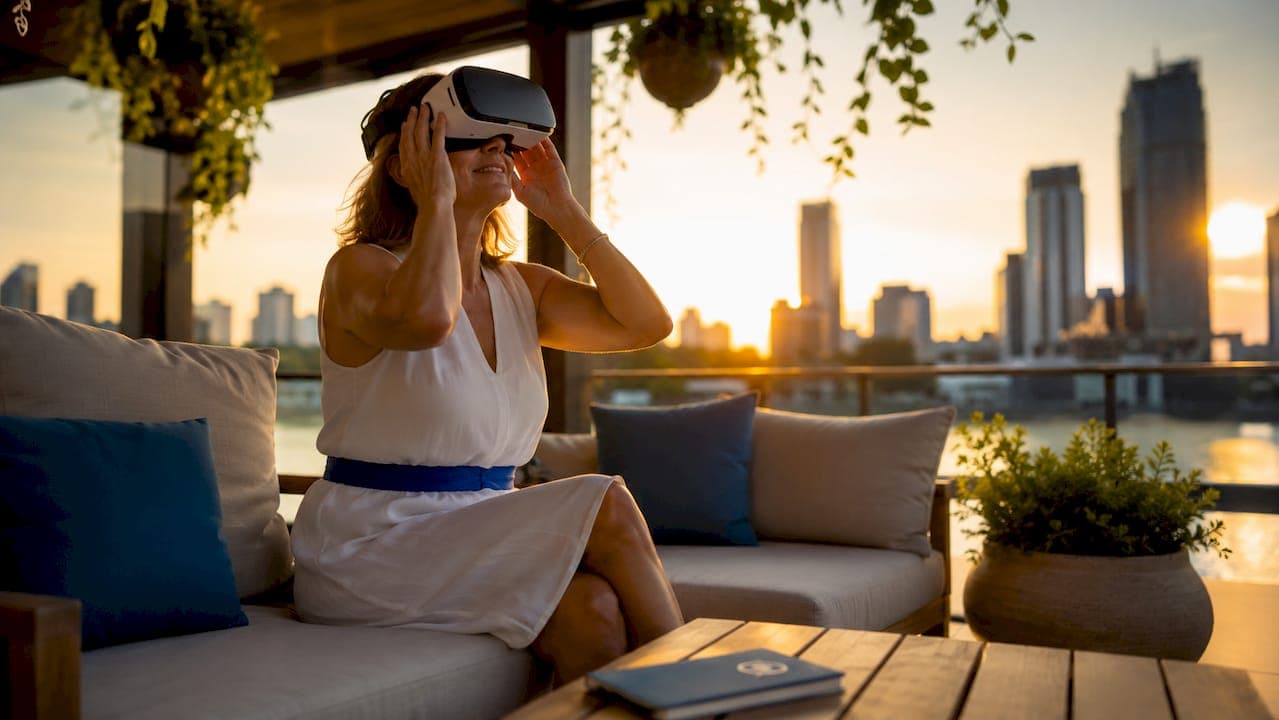
360-degree tourism videos are defined as spherical video recordings that let viewers look in any direction, simulating the physical experience of standing inside a location. Understanding how 360 degree tourism videos work matters because the technology directly drives revenue. Interactive virtual tours increase session duration by up to 311%, conversion rates by 56.8%, and average booking value by 34.8%. These numbers reflect a fundamental shift in how travelers research and commit to destinations. The industry term for the underlying format is an equirectangular projection, and it is the standard that powers everything from web browsers to VR headsets.
How 360 degree tourism videos work: camera technology and capture
The foundation of every immersive tourism video is a specialized hardware setup designed to record the full sphere of a location at once.
Camera types and lens configurations
Two main hardware approaches exist for capturing spherical panoramas. Single-unit 360 cameras, such as consumer-grade models from Insta360, use two or more wide-angle fisheye lenses positioned back-to-back. Professional multi-lens rigs mount several cameras in a geometric array, covering every angle simultaneously. The multi-lens approach produces higher resolution output and is the preferred choice for commercial tourism productions.
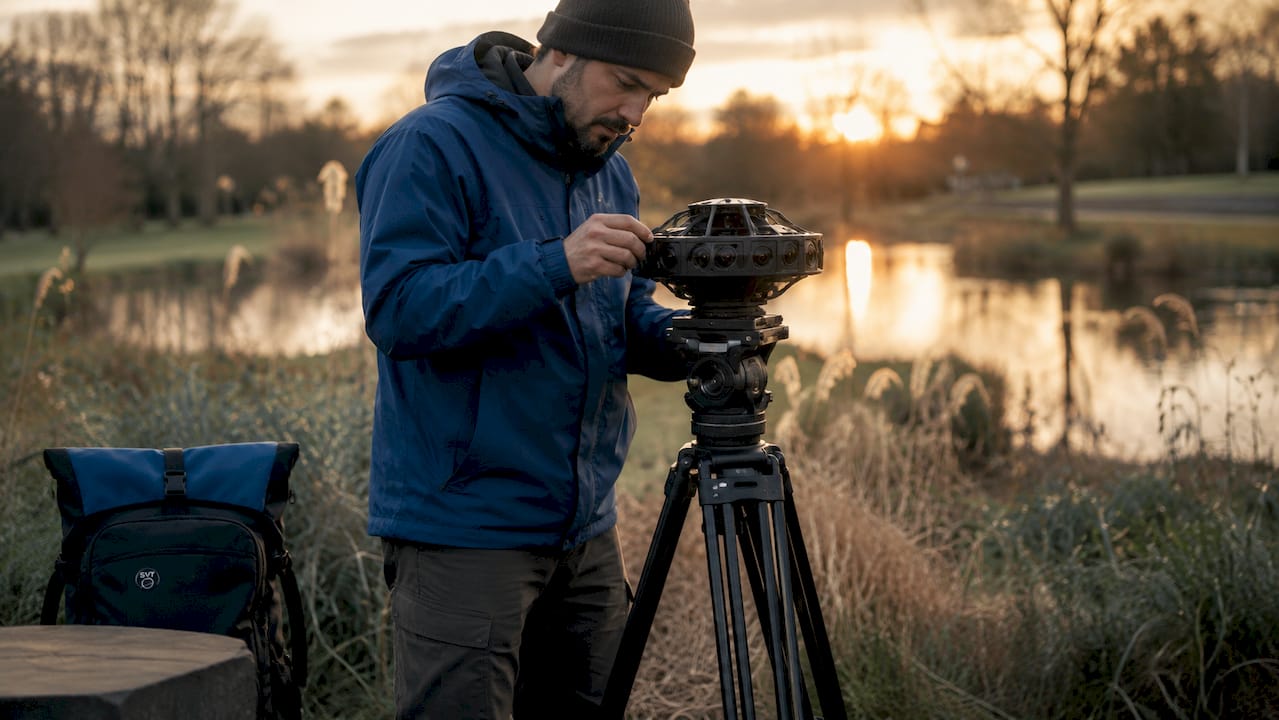
Each lens captures roughly 180 to 220 degrees of the scene. The overlapping coverage is what makes stitching possible in post-production. Without that overlap, the software has no reference points to align the images correctly.
Location, lighting, and rig mobility
Lighting conditions affect 360 video far more than standard video because every direction is visible. Harsh midday sun creates blown-out highlights on one side and deep shadows on the other. Overcast days or the golden hours around sunrise and sunset produce even, flattering light across the full sphere.
Rig mobility shapes what stories you can tell. Tripod-mounted rigs work well for static scenic shots of hotel lobbies or viewpoints. Stabilized handheld or drone-mounted rigs allow moving shots through trails, markets, or coastlines.
- Single-unit cameras: Compact, fast to deploy, ideal for social media and entry-level productions
- Multi-lens rigs: Higher resolution, greater control, required for VR headset delivery
- Drone-mounted rigs: Aerial perspectives that create a strong sense of altitude and scale
- Stabilized handheld rigs: Walking tours, markets, and active travel content
Pro Tip: Stabilize your footage at the capture stage, not just in post-production. Good production practices for travel videos include capturing wide establishing shots, medium action shots, and close-up details to maintain viewer engagement throughout the experience.
How is 360-degree footage processed into an immersive experience?
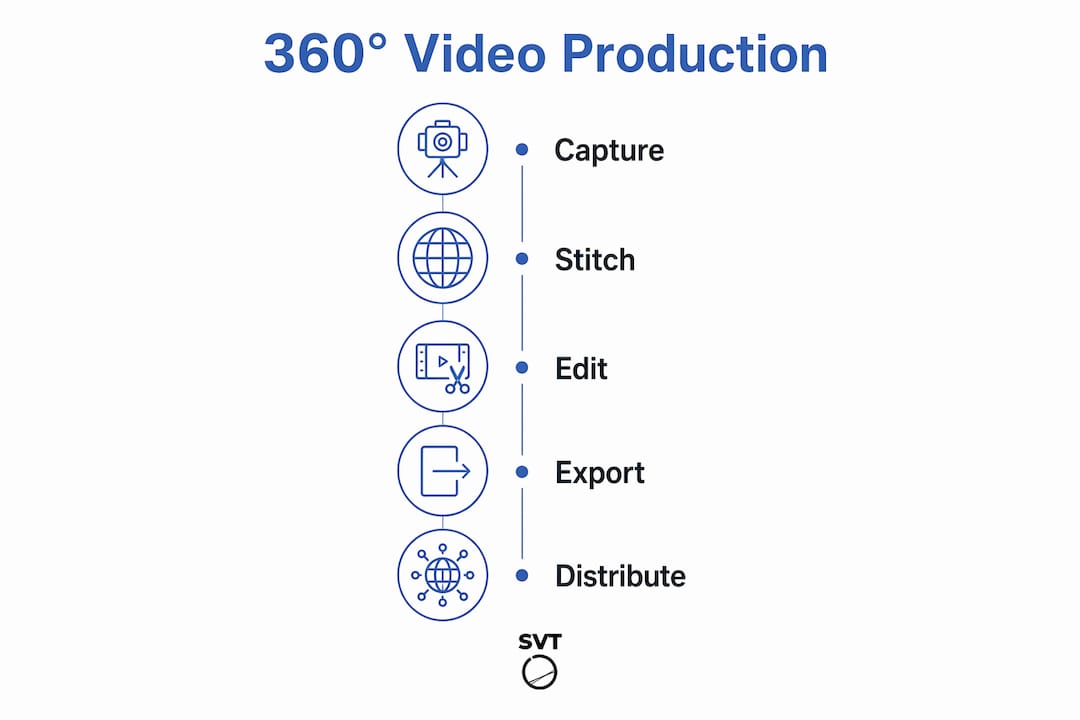
Raw footage from a 360 camera rig is not yet viewable as an immersive video. It requires a specific post-production workflow before it becomes a navigable tourism experience.
-
Stitching: Dedicated software aligns and blends the overlapping footage from each lens into a single equirectangular image. This step corrects lens distortion, color differences between cameras, and alignment errors caused by parallax. Professional stitching software analyzes thousands of matching pixels across lens borders to create a seamless spherical panorama.
-
Color grading and artifact correction: After stitching, the editor corrects any remaining seams, ghosting, or color mismatches. This step is where the visual quality of the final video is determined.
-
Spatial audio integration: Standard stereo audio sounds flat inside a 360 video. Spatial audio, also called ambisonic audio, changes volume and direction based on where the viewer is looking. A waterfall to the viewer's left gets louder when they turn toward it. This detail dramatically increases the sense of presence.
-
Embedding interactive hotspots: Interactive hotspots allow viewers to tap or click on points of interest within the video to access additional information, photos, booking links, or narration. A hotspot on a restaurant inside a resort tour can open a menu or a reservation form directly.
-
Platform optimization and export: The finished video is exported in formats suited to each delivery channel. Web delivery uses adaptive streaming to adjust quality based on connection speed. Mobile apps require gyroscope-enabled players. VR headsets need high-resolution side-by-side or top-bottom formats.
Pro Tip: Always export at the highest resolution your budget allows. Immersive 360 videos deliver to multiple platforms including web browsers, mobile devices, and VR headsets from a single production, so a high-resolution master file protects your investment across every channel.
What are the key benefits of 360-degree tourism videos?
The business case for immersive video in tourism is well established and measurable.
Engagement and conversion metrics
The numbers from real campaigns are striking. Avoriaz ski resort embedded interactive 360 virtual tours on its website and generated 43,000 new visitors along with over 7,000 email sign-ups against an original target of 1,000. Session time more than doubled. These results show that immersive content does not just attract visitors. It holds them long enough to convert.
Virtual tours remain effective SEO assets, typically accurate and relevant for 10 to 15 years, reducing user uncertainty and improving booking confidence. A single well-produced 360 tour pays dividends far longer than a standard promotional video.
The SEO benefit compounds over time. Longer session durations signal to search engines that your content satisfies user intent. Lower bounce rates improve domain authority. Both factors push your pages higher in organic search results, reducing paid acquisition costs.
Emotional engagement and traveler confidence
360-degree videos create an emotional feeling of space, altitude, and atmosphere that standard videos cannot match. This quality is crucial for selling experiential travel, where the destination itself is the product. A viewer who has virtually stood on a mountain ridge or walked through a boutique hotel lobby arrives at the booking page with far less uncertainty than one who has only seen flat photographs.
That reduction in uncertainty directly shortens the decision cycle. Travelers who feel they already know a place are more likely to book faster and at higher price points.
| Metric | Standard Video | 360-Degree Immersive Video |
|---|---|---|
| Session duration impact | Moderate increase | Up to 311% increase |
| Conversion rate lift | Incremental | Up to 56.8% increase |
| Average booking value | Baseline | Up to 34.8% increase |
| Long-term SEO value | Declines over time | Effective for 10–15 years |
| Emotional recall | Moderate | High, drives sharing behavior |
Emotional resonance created by 360 tourism video also translates into higher sharing rates and better recall among viewers compared to standard videos. Shared content extends your reach without additional media spend.
How do 360-degree videos compare to standard travel videos and virtual tours?
These three formats serve different purposes, and choosing the wrong one wastes production budget.
Standard travel videos are linear. The editor controls exactly what the viewer sees and when. This format works well for brand storytelling, emotional campaigns, and social media ads where you need to guide the viewer through a specific narrative. Production is straightforward and costs are predictable.
360-degree videos give the viewer directional control. They can look left, right, up, or down at any moment. This freedom creates a stronger sense of presence but also means the viewer may miss elements the editor intended them to see. The format excels at destination previews, hotel room tours, and scenic viewpoints where the environment itself is the message.
Fully interactive virtual tours go further still. They combine multiple 360 scenes connected by navigation hotspots, floor plans, and embedded media. A viewer can move from a hotel lobby to a guest room to a rooftop pool, clicking through at their own pace. Virtual tours built with platforms like Simple Virtual Tour add e-commerce integration, live session capabilities, and custom branding on top of the immersive base. This format works best for properties, resorts, and destinations where the goal is to replace or supplement an in-person site visit.
The practical rule is straightforward. Use standard video for awareness campaigns. Use 360 video for destination previews and social media immersion. Use interactive virtual tours when you need to drive bookings and reduce pre-purchase friction.
Key Takeaways
360-degree tourism videos work because they combine spherical capture technology, stitching software, and interactive delivery to create a measurable sense of presence that drives bookings.
| Point | Details |
|---|---|
| Spherical capture is the foundation | Multi-lens rigs and fisheye cameras record every direction simultaneously for full immersion. |
| Stitching creates the final image | Post-production software blends overlapping footage into a single equirectangular panorama. |
| Hotspots turn video into interaction | Embedded clickable points let viewers access booking links, menus, and extra content. |
| Immersive video drives measurable results | Session duration rises up to 311% and conversion rates up to 56.8% with virtual tours. |
| Format choice depends on your goal | Use 360 video for previews, interactive tours for booking conversion, and standard video for awareness. |
Why storytelling matters more than the camera you use
The most common mistake I see creators make is treating 360-degree video as a technology showcase rather than a storytelling tool. They invest in the best multi-lens rig, nail the stitching, and then deliver a static, silent panorama of an empty hotel lobby. The technology is flawless. The experience is forgettable.
What actually moves people is the feeling of being somewhere specific at a specific moment. A 360 video of a Moroccan souk at dusk, with spatial audio carrying the call to prayer and the smell of spices implied through visual richness, creates desire in a way that no spec sheet can quantify. The camera captures the sphere. The storyteller decides what fills it.
I have also seen creators assume that production complexity is a barrier. It is not the barrier it was five years ago. Consumer-grade 360 cameras now produce footage good enough for web and mobile delivery. The real skill gap is in post-production: knowing how to place hotspots that feel natural, how to sequence scenes so the viewer builds a mental map of the destination, and how to use virtual tours on social media to extend reach beyond your own website.
The future of immersive tourism content is not higher resolution. It is richer interaction. The destinations that win will be the ones that treat their 360 content as a living product, updated seasonally and connected to real booking flows.
— Andrea
Build your own immersive tourism content with Simple Virtual Tour
Creating a 360-degree tourism experience does not require a production agency or a technical team.
Simple Virtual Tour gives content creators and marketers the tools to build unlimited interactive virtual tours from their own 360 footage. The platform supports cloud-hosted and self-hosted deployments, so you control your data and your costs. With over 1,400 active users, features like live session capabilities, e-commerce integration, and an intuitive backend make it accessible regardless of your technical background. You can start building tours that work across web, mobile, and VR devices without writing a single line of code.
FAQ
What equipment do you need to film 360-degree tourism videos?
You need a camera with at least two wide-angle fisheye lenses to capture the full sphere. Consumer single-unit cameras work for web and mobile delivery, while professional multi-lens rigs are required for VR headset output.
How long does it take to produce a 360-degree tourism video?
Production time varies by complexity. A single-scene 360 video with basic stitching and color correction can be completed in a few hours, while a fully interactive multi-scene virtual tour with hotspots and spatial audio typically takes several days.
What platforms can 360-degree tourism videos be viewed on?
Immersive 360 videos deliver to web browsers, mobile devices, and VR headsets from a single production, making them one of the most versatile formats in tourism marketing.
How do 360-degree tourism videos improve SEO?
Longer session durations and lower bounce rates signal content quality to search engines. Virtual tours are effective SEO assets for 10–15 years, consistently improving organic search rankings over time.
What is the difference between a 360-degree video and an interactive virtual tour?
A 360-degree video lets viewers look in any direction within a single scene. An interactive virtual tour connects multiple 360 scenes through clickable hotspots, allowing viewers to navigate between locations and access embedded content like booking links or floor plans.