
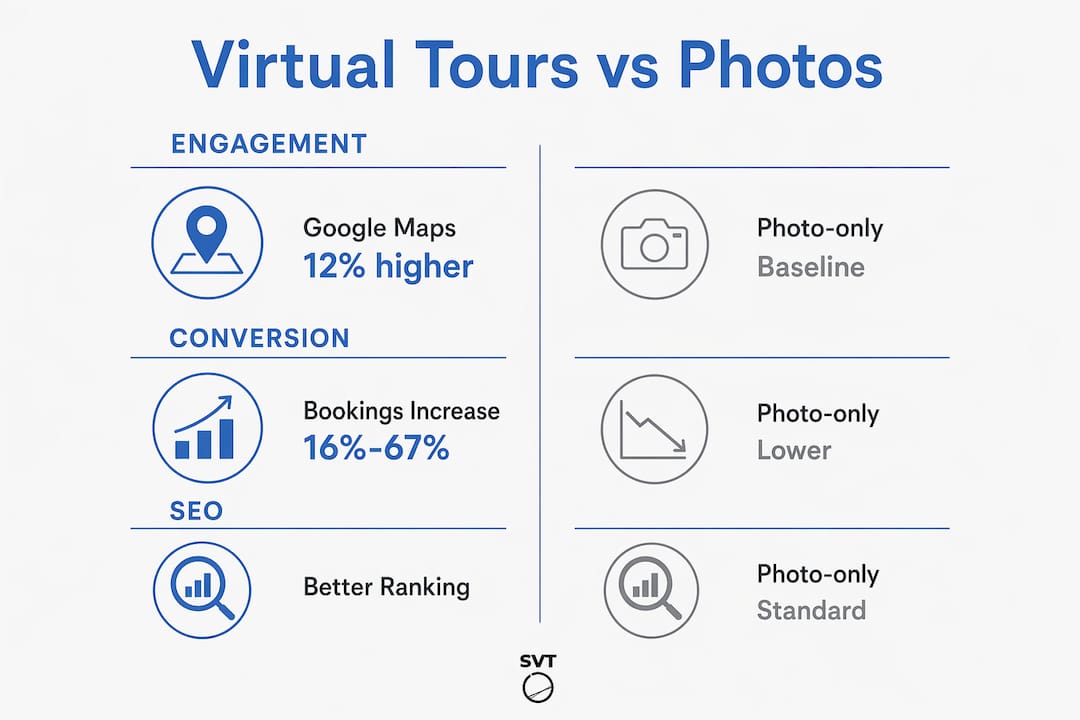
Virtual venue tours are immersive, interactive 360-degree digital representations of physical spaces that let viewers explore a venue at their own pace, from any device. The reason why virtual venue tours work on social media comes down to one core fact: they combine the emotional pull of visual content with the functional depth that converts browsers into bookers. Businesses using virtual tours report a 16% to 67% increase in bookings, and listings on Google Maps with virtual tours receive 12% higher engagement than photo-only listings. Simple Virtual Tour gives marketers and business owners the tools to build and publish these experiences without technical expertise.
Why virtual venue tours work on social media for venue marketing
Social media sells the feeling of a venue. A well-edited reel of a sunlit ballroom or a candlelit rooftop creates desire. But desire alone does not close a booking. Clients need to evaluate the space before they commit, and that is where the standard marketing funnel breaks down for most venues.
Virtual tours fill that gap. Social media sells the emotional appeal while virtual tours satisfy the functional need for transparency, making them a complementary marketing pairing. A prospect sees your Instagram reel, feels excited, then clicks through to a 360-degree tour to check ceiling height, room flow, and natural light. That sequence moves them from interest to intent faster than any static gallery can.

The psychological mechanism behind this is well documented. Virtual tours give users presence and perceived control that reduce cognitive load and increase trust, leading to a higher likelihood of purchase compared to passive video. When a viewer controls where they look and how long they linger, they feel more confident in their decision.
Here is what this means practically for your content strategy:
- Reels and Stories generate the emotional hook and drive traffic to the tour link.
- Interactive hotspots inside the tour answer common questions without a sales call.
- Self-guided exploration builds trust because clients feel they discovered the space themselves, not that they were shown a curated highlight reel.
- Tour links in bio or link-in-bio tools create a direct path from social engagement to deep venue evaluation.
Pro Tip: Post a short 15-second clip of one specific tour stop, such as the bridal suite or the main reception hall, as a Reel. End with a clear call to action directing viewers to the full tour. This micro-content approach drives higher click-through rates than posting a generic "take our virtual tour" prompt.
What engagement and conversion benefits do virtual tours deliver?
The data on virtual tour performance is specific and consistent. Pages with embedded 360-degree tours see a 40% increase in website engagement after the tours go live. Users also spend 5–10 times longer on pages that feature virtual tours compared to pages with photos only. Longer dwell time signals quality content to search engines, which improves local SEO rankings.
The conversion numbers are equally strong. One venue case study showed bookings rising from 2 to 12 per month after combining social media storytelling with virtual tour access. That is a sixfold increase driven by a content strategy, not a price cut or a new product.
Virtual tours act as a 24/7 open house, breaking geographic barriers and transforming how clients experience venue spaces remotely. A prospect in another city can fully evaluate your space at midnight on a Sunday, and arrive at your inbox already sold on the venue.
Virtual tours also reduce unnecessary physical visits by about 40%. That matters for your team's time and for the quality of the visits that do happen. Clients who walk through your door after completing a virtual tour are pre-qualified. They already know the layout, the scale, and the aesthetic. Your in-person meeting becomes a confirmation, not an introduction.
The SEO benefit compounds over time. Pages with interactive 360 virtual tours outperform photography-only competitors in local search rankings, with 95% of high-performing venue listings integrating platforms like Google Street View. Social media profiles that link to embedded tours also benefit from the increased dwell time those tours generate on your website.
| Metric | Virtual tours | Photo-only listings |
|---|---|---|
| Google Maps engagement | 12% higher | Baseline |
| Website dwell time | 5–10x longer | Baseline |
| Booking conversion increase | 16%–67% | Baseline |
| Reduction in unnecessary site visits | ~40% fewer | No reduction |
| Booking cycle length | 35%–40% shorter | Baseline |
How to use virtual venue tours effectively on social media
Distributing a virtual tour on social media is not a single action. It is a repeatable content system. Each platform serves a different stage of the buyer's awareness, and your tour content should match that stage.
- Instagram and Facebook: Use Reels and Stories to highlight individual rooms or features. Link the full tour in your bio or use a link-in-bio page. Stories with "Swipe Up" or link stickers convert well when paired with a specific room preview.
- YouTube: Publish a narrated walkthrough video that guides viewers through the tour highlights. This builds search visibility on YouTube, the world's second-largest search engine, and drives traffic back to the interactive version on your website.
- LinkedIn: Target corporate event planners and HR teams by sharing the tour alongside capacity and amenity details. LinkedIn audiences respond to functional information, not just aesthetics.
- Facebook Events and Groups: Embed or link the tour directly in event listings and local venue-focused groups. This gives undecided prospects a way to evaluate the space without scheduling a call.
- Google Business Profile: Integrate your 360-degree tour with your Google Business listing. This directly feeds the local SEO benefit and puts your tour in front of high-intent searchers.
Pro Tip: Apply lazy loading and responsive CSS wrappers when embedding your tour on any webpage linked from social media. These techniques ensure the tour loads fast on mobile devices, which is where the majority of social media traffic originates. A slow-loading tour loses the viewer before they even begin exploring.
For social media campaigns that integrate 360-degree tours, the most effective approach treats each tour stop as its own piece of content. A 10-room venue gives you at least 10 distinct posts, each with a specific hook and a link to that exact location inside the tour.
How do virtual tours compare to traditional photography and video?
Traditional photography is the right tool for inspiration. A beautifully lit hero shot of your main hall belongs on your homepage and your Instagram feed. It creates desire quickly and works well in paid ads. But photography has a hard limit: it shows one fixed viewpoint, chosen by the photographer, not the client.
Video solves the fixed-viewpoint problem but introduces a different constraint. A walkthrough video is linear. The viewer watches what the videographer decided to show, in the order they decided to show it. There is no user control, and virtual tours offer users presence and perceived control that passive video simply cannot replicate.
Virtual tours serve as 24/7 virtual open houses, removing geographic barriers and the guesswork that static images leave behind. They also deliver measurable results that photography and video do not. Booking cycles shorten by 35%–40% when venues use virtual tours, and last-minute cancellations drop because clients arrive with accurate expectations. You can also explore why interactive tours outperform photo galleries in depth for a detailed breakdown of the performance gap.
The practical conclusion is that these formats are not competitors. Photography creates the first impression. Video builds atmosphere. Virtual tours close the evaluation gap and accelerate the decision. A venue marketing strategy that uses all three, with virtual tours as the conversion layer, outperforms any single-format approach.
Key Takeaways
Virtual venue tours work on social media because they convert emotional interest into confident booking decisions by giving prospects full, self-directed control over how they evaluate a space.
| Point | Details |
|---|---|
| Tours convert where photos stop | Bookings increase 16%–67% when venues add virtual tours to their marketing mix. |
| Dwell time drives SEO | Users spend 5–10x longer on pages with virtual tours, improving local search rankings. |
| Social media and tours are complementary | Reels create desire; virtual tours satisfy the need for transparency and build trust. |
| Each tour stop is content | A multi-room venue generates dozens of distinct social posts from a single tour. |
| Mobile optimization is non-negotiable | Lazy loading and responsive embeds keep tours fast for social media traffic on mobile. |
What I've learned from watching venues use tours in their social strategy
The venues that get the most from virtual tours are not the ones with the biggest budgets. They are the ones that treat the tour as a living content asset, not a one-time production. I have watched business owners publish a tour, link it once in their bio, and then wonder why nothing changed. The tour did not fail. The distribution strategy did.
The shift happens when you start thinking of each room, each feature, and each hotspot as its own piece of content. A bridal suite becomes a Reel. The catering kitchen becomes a LinkedIn post for corporate planners. The rooftop view becomes a Story with a poll asking followers which setup they prefer. The tour is the source material. Social media is the distribution engine.
The other mistake I see consistently is ignoring mobile load speed. Most social media traffic hits your tour on a phone, often on a cellular connection. If the embed takes more than three seconds to load, you have already lost the viewer. Technical details like lazy loading for mobile are not optional polish. They are the difference between a tour that converts and one that bounces.
My honest recommendation: build your tour, then build a 30-day content calendar around it before you publish anything. Map each post to a specific room or feature, assign it to a platform, and write the call to action before you shoot the clip. That preparation turns a single tour into months of content that consistently drives traffic back to the evaluation experience your prospects actually need. You can find a practical starting point in this venue manager's guide to showcasing event spaces online.
— Andrea
Simple Virtual Tour: build your venue's 360-degree marketing asset
Creating a professional virtual tour used to require a production team and a significant budget. Simple Virtual Tour changes that equation entirely.
Simple Virtual Tour is software built for business owners and marketers who need to create unlimited interactive virtual tours without hiring developers or learning complex tools. The platform supports both cloud-hosted and self-hosted deployment, giving you full control over your data and your costs. Features include live session capabilities, e-commerce integration, and interactive hotspots, all managed through an intuitive backend. Over 1,400 users currently rely on it to showcase spaces and shorten booking cycles. Start building your tour and turn your venue into a 24/7 sales asset.
FAQ
What makes virtual venue tours effective on social media?
Virtual tours give viewers self-directed control over how they explore a space, which builds trust faster than photos or video. This perceived control directly increases the likelihood of a booking decision.
How much can a virtual tour increase bookings?
Businesses that add virtual tours to their marketing report a 16% to 67% increase in bookings. The range depends on how actively the tour is promoted across social and search channels.
Which social media platforms work best for promoting venue tours?
Instagram and Facebook work best for emotional, visual promotion through Reels and Stories. LinkedIn reaches corporate event planners, and YouTube builds long-term search visibility for narrated tour walkthroughs.
Do virtual tours help with local SEO?
Pages with embedded 360-degree virtual tours outperform photography-only pages in local search rankings. Google Maps listings with virtual tours also receive 12% higher engagement than listings without them.
How do virtual tours reduce unnecessary site visits?
Prospects who complete a virtual tour arrive pre-qualified, having already evaluated layout, scale, and aesthetics remotely. This reduces unnecessary physical visits by approximately 40% and shortens the overall booking cycle by 35%–40%.