
Interactive virtual tours are immersive, 360-degree digital experiences that let users navigate a space at their own pace, unlike static photo galleries that present a fixed sequence of images. The gap in performance between the two formats is not subtle. Listings with virtual tours generate 87% more views than those with photos alone, and users spend 3 to 6 times longer exploring them. For marketing professionals and business owners, understanding why interactive tours outperform photo galleries is the difference between a passive browsing experience and a conversion-driving one. Platforms like Simple Virtual Tour make this technology accessible to businesses of any size, without requiring technical expertise.
Why do interactive tours outperform photo galleries for engagement?
User engagement tells the whole story. Photo galleries hold a visitor's attention for roughly 20 seconds, while interactive virtual tours keep users engaged for 5 to 10 minutes. That is not a marginal difference. It is a behavioral shift from passive scrolling to active exploration.
The reason is control. When a user navigates a virtual tour, they choose where to look, which rooms to enter, and how long to stay in each space. Photo galleries remove that control entirely. A photographer decides the angle, the sequence, and what gets shown. The viewer simply accepts it. This curation bias can create skepticism, especially among buyers who know that flattering angles hide awkward layouts.
Visitors who engage with virtual tours are up to 67% more likely to make a booking or purchase compared to those who rely on photos alone. That statistic reflects a deeper psychological truth: when people feel in control of an experience, their confidence in the decision increases. The 18–34 age group shows this effect most sharply, with that demographic being 130% more likely to book a viewing after experiencing a 3D tour.
Shifting from passive viewing to active exploration also eliminates the suspicion that a seller is hiding something. Buyers who can freely navigate a space arrive at their decisions faster and with greater confidence. That confidence is what drives conversions.
What operational advantages do interactive tours give businesses?
The engagement benefits are compelling, but the operational case is equally strong. Interactive tours deliver 40% more qualified leads and reduce low-intent inquiries by up to 67%. For a real estate agent or hotel sales team, that shift in lead quality changes the entire workload.
Here is what that looks like in practice:
- Real estate agents spend less time on property showings with buyers who were never serious. Virtual tours pre-qualify prospects before any in-person visit occurs.
- Hotels see 28% fewer cancellations when guests book after viewing a virtual tour, because expectations match reality on arrival.
- Relocation buyers can make confident decisions about properties in cities they have not yet visited, removing geographic barriers from the sales cycle.
- Sales cycles shorten because high-intent buyers arrive already familiar with the space, reducing the number of follow-up questions and repeat visits.
Properties with virtual tours also sell up to 31% faster and can command up to 9% higher prices. The speed gain comes from buyers self-selecting. A person who has already spent eight minutes exploring a floor plan is far closer to a decision than someone who glanced at six photos.
Pro Tip: Design your virtual tour to answer the questions buyers ask most often. Include hotspots that show room dimensions, storage space, and natural light at different times of day. Buyers who find answers inside the tour rarely need a follow-up call.
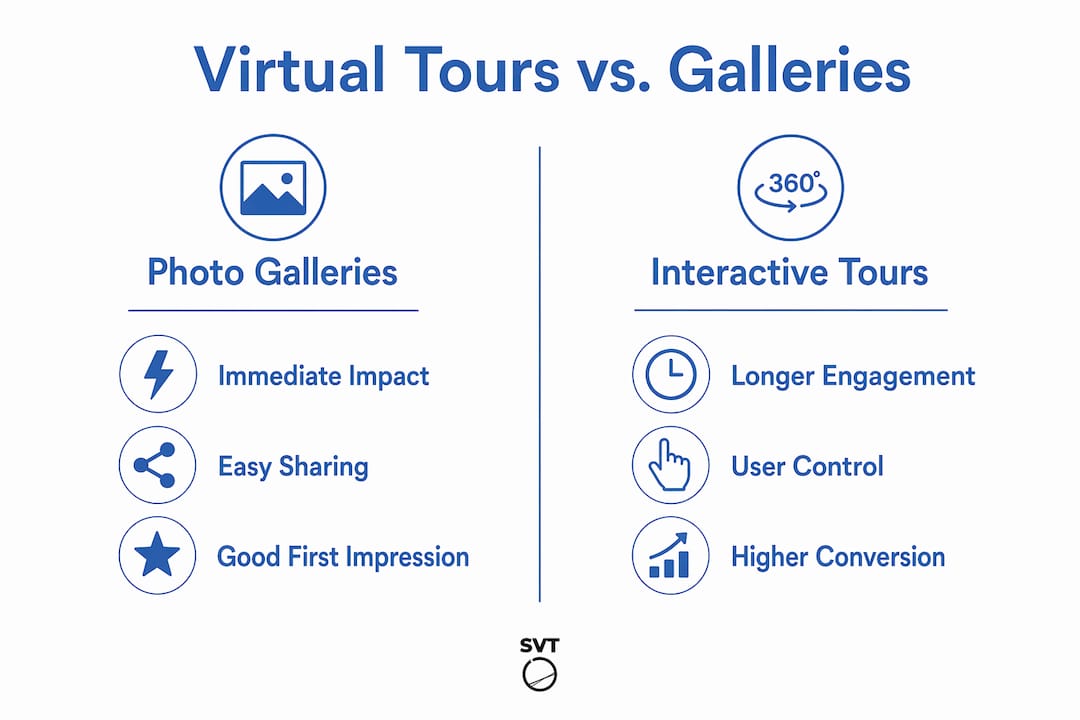
How do interactive tours compare with photo galleries feature by feature?
Photo galleries and virtual tours serve different purposes, and understanding that distinction helps you deploy each one correctly.
| Feature | Photo galleries | Interactive virtual tours |
|---|---|---|
| First impression speed | Immediate, no click-through required | Requires user to initiate the experience |
| Spatial understanding | Limited to photographer's chosen angles | Full 360-degree navigation of every room |
| Average time on page | Approximately 20 seconds | 5–10 minutes |
| Lead qualification | Low; attracts casual browsers | High; filters serious buyers naturally |
| Booking conversion lift | Baseline | Up to 67% higher likelihood to book |
| Out-of-town buyer appeal | Moderate | Strong; removes need for travel before deciding |
| SEO time-on-site signal | Weak | Strong; favored by Google as a quality signal |
| Sharing and social use | Easy; images share natively | Shareable via link; requires compatible viewer |
Photo galleries excel at immediate first impressions and frictionless sharing across social platforms. A well-shot hero image stops a scroll. Virtual tours, by contrast, require the user to click through and engage, which means they work best once a prospect is already interested enough to explore.
The most effective marketing approach uses both. Lead with professional photography to capture attention in listings, social ads, and email campaigns. Then let the virtual tour do the heavy lifting once a prospect clicks through to your property page or website. Each format reinforces the other rather than competing.
Virtual tours communicate venue ambiance in ways that photos simply cannot. The sense of scale, flow between rooms, and spatial relationships between areas all become clear when a user can navigate freely.
What best practices maximize the benefits of interactive tours in marketing?
Deploying a virtual tour is not enough on its own. How you integrate it into your marketing workflow determines whether it drives results or sits unused on a property page.
-
Place the tour early in the buyer journey. Embed it on your primary listing page, not buried in a gallery tab. Buyers who find the tour quickly are more likely to engage with it before losing interest.
-
Add participatory design features. Interactive hotspots, real-time Q&A, and embedded galleries maintain engagement and help distinguish serious buyers from casual browsers. A hotspot on a kitchen that links to appliance specs or renovation history gives buyers information they would otherwise request by phone.
-
Optimize for mobile from the start. Over 70% of web traffic comes from mobile devices, and a tour that performs poorly on a phone loses the majority of your audience. Test navigation, load speed, and hotspot tap targets on multiple screen sizes before publishing.
-
Combine live guided sessions with self-directed tours. Live virtual guided tours let agents or hosts walk prospects through a space in real time, answering questions as they arise. This format works especially well for high-value properties where personal connection matters.
-
Use the SEO advantage deliberately. Higher time-on-site is a positive quality signal for Google rankings. When a visitor spends seven minutes on your property page instead of twenty seconds, that behavior tells Google your content is worth ranking. Pair your tour with descriptive text, location keywords, and structured data to compound the effect.
Pro Tip: Place a clear call-to-action inside the tour itself, not just on the surrounding page. A booking prompt or contact form that appears after a user has explored three or more rooms catches them at peak interest, when they are most likely to act.
Mobile-optimized tour design is not optional in 2026. It is the baseline expectation for any buyer or guest who discovers your listing on a phone during a commute or lunch break.
Interactive tours that incorporate real-time engagement tools also reduce marketing friction by helping serious buyers self-identify early. When a prospect spends ten minutes in a tour and then submits a contact form, your sales team already knows they are worth prioritizing.
Key takeaways
Interactive virtual tours outperform photo galleries because they replace passive viewing with active exploration, producing measurably higher engagement, better lead quality, and faster conversion across real estate, hospitality, and beyond.
| Point | Details |
|---|---|
| Engagement time gap | Virtual tours hold attention for 5–10 minutes vs. roughly 20 seconds for photo galleries. |
| Conversion lift | Visitors who use virtual tours are up to 67% more likely to book or purchase. |
| Lead quality improvement | Interactive tours deliver 40% more qualified leads and cut low-intent inquiries by up to 67%. |
| Sales speed | Properties with virtual tours sell up to 31% faster than those with photos alone. |
| Best deployment strategy | Lead with professional photos for first impressions, then use virtual tours to deepen engagement and close. |
Why I think most businesses are still underusing this format
I have watched marketing teams spend significant budgets on professional photography and then wonder why their conversion rates stay flat. The photos look great. The listings get views. But visitors leave without acting. The missing piece is almost always depth of experience.
What I find most telling is the cancellation data. Hotels that show virtual tours before booking see 28% fewer cancellations. That number reveals something important: most booking regret comes from unmet expectations, and photos are too curated to set accurate ones. A virtual tour shows the actual size of a room, the view from the window, and the distance from the elevator. It removes the gap between expectation and reality before money changes hands.
The businesses I have seen get the most from virtual tours treat them as a filtering tool, not just a showcase. They design tours that answer hard questions upfront, and they track which hotspots get the most interaction to understand what buyers actually care about. That feedback loop makes every subsequent marketing decision sharper.
My prediction for the next few years is straightforward: buyers and guests will begin to expect virtual tours the way they now expect multiple photos. Businesses that build the capability now will have a head start. Those that wait will be catching up.
— Andrea
See interactive tours in action with Simple Virtual Tour
Simple Virtual Tour gives you everything you need to build unlimited interactive virtual tours without writing a single line of code. The platform supports both cloud-hosted and self-hosted deployments, so you keep full control over your data and avoid recurring hosting fees. Features like live session capabilities, e-commerce integration, and built-in hotspot tools let you create the kind of participatory experiences that convert browsers into buyers. Over 1,400 businesses already use it to showcase properties, venues, and spaces more effectively than static photos ever could. Start building your tours and see the engagement difference for yourself.
FAQ
How much more engagement do virtual tours get vs. photos?
Virtual tours keep visitors engaged for 5–10 minutes compared to roughly 20 seconds for photo galleries. Listings with virtual tours also generate 87% more views than photo-only listings.
Do interactive tours actually improve conversion rates?
Visitors who engage with virtual tours are up to 67% more likely to book or purchase than those who view photos alone. Real estate properties with 3D tours sell up to 31% faster and can command up to 9% higher prices.
Are virtual tours worth it for small businesses?
Virtual tours deliver 40% more qualified leads and reduce low-intent inquiries by up to 67%, which means smaller teams spend less time on prospects who were never going to buy. The return on investment compounds over time as the tour continues working without additional cost.
Do virtual tours help with Google rankings?
Extended time-on-site from virtual tours is a positive quality signal for Google's ranking algorithm. When visitors spend several minutes on your page instead of seconds, Google treats that as evidence your content is worth surfacing in search results.
Should I replace photos with virtual tours?
Photo galleries and virtual tours work best together. Use professional photography to capture attention in ads and listings, then use a virtual tour to deepen engagement once a prospect clicks through to your page.