

Virtual tours are defined as interactive, 360-degree digital experiences that let prospects explore a space remotely before committing to a physical visit. Research from 2026 shows that properties with 3D virtual tours sell up to 31% faster, reducing average time on market by 10–15 days. That single data point explains why real estate agents, hotel operators, and event venue managers are adopting virtual tour technology at a rapid pace. Platforms like Simple Virtual Tour and Matterport have made this technology accessible to businesses of every size, turning what was once a luxury into a standard sales tool. Understanding how virtual tours shorten customer decision cycles gives you a direct competitive advantage in any market where speed matters.
How virtual tours shorten customer decision cycles through deeper engagement
The core mechanism is simple: immersive experiences hold attention longer than static photos, and longer attention translates into faster decisions. Hospitality and retail websites with virtual tours report up to 300% higher engagement compared to sites using only traditional images. That level of engagement means prospects are spending real time inside your space, not just glancing at a thumbnail and moving on.

Longer session times build the kind of confidence that accelerates buying decisions. When a prospective hotel guest can walk through a suite, check the view from the balcony, and inspect the bathroom layout, they answer their own questions without waiting for a sales call. The same applies to event planners evaluating a ballroom or retail customers browsing a showroom. Each answered question removes a reason to delay.
Virtual tours also outperform static media in one critical way: they support interactive features that static photos cannot. Hotspots can display room dimensions, pricing, or availability. Shoppable tags let customers add items to a cart directly from the tour. These features keep prospects in a buying mindset rather than pulling them out of the experience to search for information elsewhere.
- Hotspots and info tags surface key details like square footage, pricing, and availability without requiring the prospect to leave the tour.
- Shoppable tags connect product discovery directly to purchase, cutting steps out of the buying process.
- Floor plan overlays give spatial context that photos cannot provide, reducing uncertainty about layout and flow.
- Mobile optimization ensures the experience works on any device, reaching prospects wherever they are.
Pro Tip: Embed your virtual tour directly on your listing or booking page rather than linking to an external platform. Keeping prospects on your site reduces drop-off and keeps them in a focused buying state.
Do virtual tours actually qualify leads before the first conversation?
Virtual tours act as a filter, not just a showcase. 76% of buyers skip in-person viewings when a high-quality virtual tour already meets their detail needs. This pre-qualification effect produces 40–49% more qualified leads compared to listings that rely only on 2D photos. The prospect who books a showing after completing a virtual tour has already answered their own deal-breaker questions.
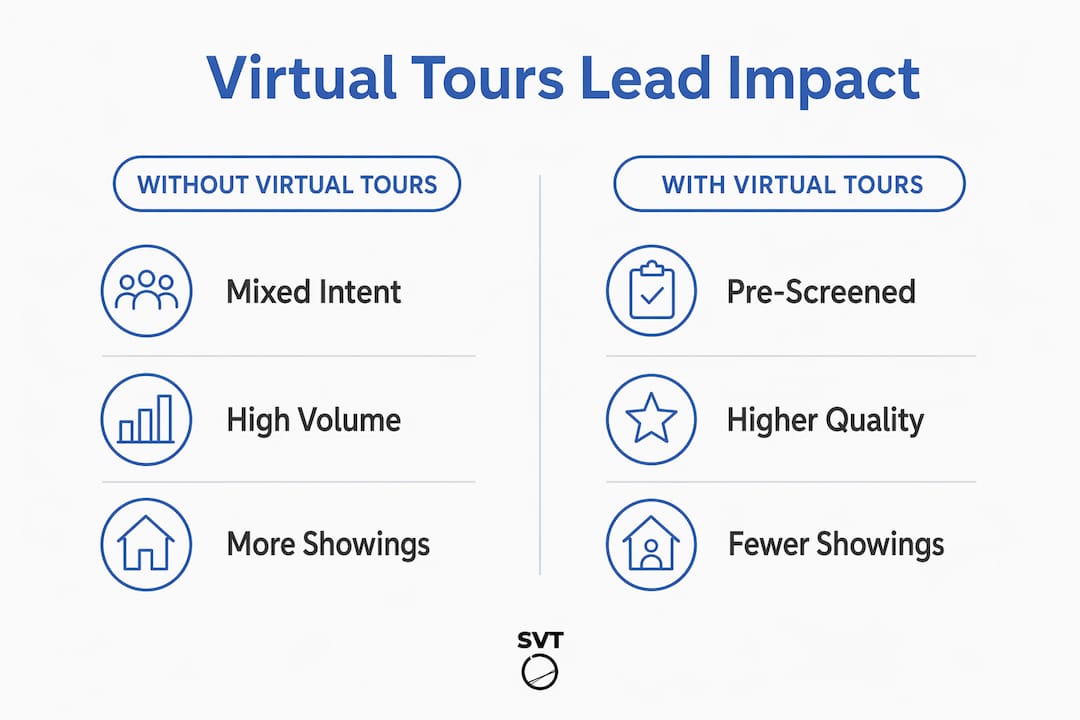
The time savings compound quickly. Virtual tours reduce unproductive showings by approximately 40%, freeing agents and sales teams to focus on prospects who are genuinely ready to move forward. Fewer low-intent visits mean lower carrying costs, less scheduling friction, and more energy directed at closing.
Engagement time itself becomes a lead-scoring signal. Qualified prospects spend between 5 and 10 minutes inside a virtual tour. A prospect who spends that long exploring a space is signaling serious intent. Sales teams can use this data to prioritize follow-up, contacting high-engagement prospects first and letting low-engagement ones self-select out.
Virtual tours also shift pre-booking inquiries to automated platforms, letting prospects answer deal-breaker questions independently. This reduces the volume of repetitive inquiries your team handles and shortens the time between first contact and a committed decision.
| Factor | Without virtual tours | With virtual tours |
|---|---|---|
| Lead quality | Mixed intent, high volume | Pre-screened, higher intent |
| Unproductive showings | High frequency | Reduced by ~40% |
| Time to qualified conversation | Multiple touchpoints required | Faster, fewer steps |
| Prospect self-screening | Minimal | High, driven by tour detail |
| Sales team focus | Spread across all inquiries | Concentrated on serious buyers |
Pro Tip: Connect your virtual tour platform to your CRM so that session duration and interaction data feed directly into your lead scoring. Prospects who explore for more than five minutes deserve a same-day follow-up.
How virtual tours speed up sales in real estate, tourism, and event planning
Each industry benefits from virtual tours in a specific way, and the data across all three sectors points in the same direction: faster decisions.
Real estate
Properties with 3D virtual tours sell up to 31% faster and spend 10–15 fewer days on the market. Remote buyers are a major driver of this effect. Virtual tours expand geographic buyer pools by enabling initial shortlisting without a physical visit. A buyer relocating from another city can narrow a list of 20 properties to 3 before ever boarding a plane. That compression of the early decision stage is where most of the time savings occur.
Hospitality and tourism
Websites with embedded 3D tours see booking conversions increase by up to 12% due to reduced uncertainty. A traveler who has already walked through a hotel lobby and inspected a room type is far less likely to abandon the booking process. Tourist attractions and tour operators benefit similarly. When a prospect can preview an experience before purchasing, the perceived risk of the transaction drops, and decisions happen faster.
Event planning
Event venues face a specific challenge: planners need to evaluate capacity, layout, lighting, and ambiance before committing to a contract. A virtual tour addresses all four concerns in a single session. Integrating tours with live booking engines is critical here. When a planner finishes exploring a venue and can immediately check availability or request a quote without leaving the experience, the momentum toward a decision stays intact.
| Industry | Key benefit | Measurable outcome |
|---|---|---|
| Real estate | Remote shortlisting, fewer showings | 31% faster sales, 10–15 days less on market |
| Hospitality and tourism | Reduced booking uncertainty | Up to 12% increase in conversions |
| Event planning | Full venue evaluation before site visit | Faster contract decisions, fewer site visits |
What features and practices make virtual tours most effective?
The technology behind a virtual tour matters as much as the decision to create one. A low-resolution, slow-loading tour increases uncertainty rather than reducing it. High-quality 3D imaging, fast load times, and mobile-optimized tours are the baseline requirements for any tour that is meant to accelerate decisions.
Transparency is the second critical factor. Successful virtual tours include floor plans, measurements, and functional details that let prospects complete functional discovery before a physical visit. A tour that shows beautiful imagery but hides the room dimensions or the proximity to a service entrance leaves questions unanswered. Unanswered questions delay decisions.
Live guided tours add another layer of effectiveness. Platforms like Simple Virtual Tour include live session capabilities, allowing a sales agent to walk a remote prospect through a space in real time, answer questions on the spot, and guide attention to the features that matter most. This format combines the efficiency of a virtual tour with the persuasive power of a human conversation. Research on live session real estate tours confirms that this hybrid approach reduces the number of follow-up touchpoints needed before a decision.
Virtual tours also deliver lasting ROI. The cost per tour averages around $350 and is recouped through reduced carrying costs and improved workflow efficiency over months or years. That makes virtual tours one of the few sales tools where the upfront investment compounds over time rather than expiring after a single campaign.
Key Takeaways
Virtual tours shorten customer decision cycles by combining immersive engagement, lead pre-qualification, and direct integration with booking or sales workflows across real estate, tourism, and event planning.
| Point | Details |
|---|---|
| Faster sales timelines | Properties with 3D virtual tours sell up to 31% faster and spend 10–15 fewer days on the market. |
| Higher lead quality | Virtual tours produce 40–49% more qualified leads by letting prospects self-screen before any sales contact. |
| Reduced unproductive visits | Approximately 40% fewer in-person showings are needed when a detailed virtual tour is available. |
| Engagement as a buying signal | Prospects who spend 5–10 minutes in a tour signal serious intent and should receive priority follow-up. |
| Booking conversion lift | Hospitality and event sites with virtual tours see up to 12% higher booking conversions. |
Why I think most businesses are still using virtual tours wrong
Most businesses treat virtual tours as a marketing asset. They publish one, add it to a listing, and wait. That approach captures only a fraction of the value.
The real power of a virtual tour is operational. The business value lies in reducing unproductive showings and improving workflow efficiency, not in generating a flashy first impression. When you connect tour engagement data to your CRM, use session time as a lead-scoring input, and integrate booking directly into the tour experience, you are using the technology the way it was designed to be used.
I have watched real estate teams cut their average showing schedule in half simply by requiring prospects to complete a virtual tour before booking an in-person visit. Event venues that added a booking request button inside their tour saw inquiry-to-contract timelines drop noticeably. These are not marginal improvements. They are structural changes to how the sales process works.
The one mistake I see repeatedly is treating virtual tours as a replacement for physical visits. They are not. They are a filter and a qualifier. The goal is to make sure that every in-person visit involves a prospect who already wants to be there. When you use virtual tours that way, the decision cycle does not just get shorter. It gets better for everyone involved.
— Andrea
Simple Virtual Tour: built for businesses that need results fast
Shortening your sales cycle starts with having a tour that is actually worth exploring. Simple Virtual Tour gives you the tools to build unlimited interactive virtual tours without needing technical expertise.
Simple Virtual Tour supports both cloud-hosted and self-hosted deployments, so you control your data and your costs. The platform includes live session capabilities for guided tours, e-commerce integration for shoppable experiences, and an intuitive backend that over 1,400 businesses already use to engage clients and qualify leads faster. Whether you are in real estate, hospitality, or event planning, you can create your first tour and start compressing your decision cycles today. Visit Simple Virtual Tour to see the full feature set and pricing.
FAQ
How do virtual tours speed up buying decisions?
Virtual tours let prospects answer their own questions before any sales contact, removing the back-and-forth that delays decisions. Prospects who complete a detailed tour arrive at conversations already pre-qualified and ready to move forward.
What industries benefit most from virtual tours?
Real estate, hospitality, and event planning see the strongest results. Properties with 3D tours sell up to 31% faster, and hospitality sites report up to 12% higher booking conversions when tours are available.
Do virtual tours replace in-person visits?
Virtual tours are pre-visit filters, not replacements. Their primary function is to eliminate low-intent prospects so that every in-person visit involves a serious buyer or planner.
How do I measure whether a virtual tour is working?
Track session duration, interaction with hotspots, and the ratio of tour completions to follow-up inquiries. Prospects who spend 5–10 minutes in a tour are statistically more likely to convert, making engagement time your most reliable signal.
What makes a virtual tour effective at shortening decision cycles?
High image quality, transparent details like floor plans and measurements, mobile optimization, and direct integration with booking or inquiry systems are the four factors that separate tours that accelerate decisions from tours that simply look good.