

Get a signed property release from the owner or authorized representative before you publish any commercial virtual tour. If you can't secure one right away, strip geotags from the file and publish through a private, password-protected embed instead of a public link. Industry guidance from stock libraries like Stocksy and Getty Images treats releases as standard practice, and a workflow built through Simple Virtual Tour can help you manage both the paperwork and the publishing controls.
TL;DR:
- Obtaining a property release is essential for commercial virtual tours featuring recognizable or unique spaces, especially when intended for public marketing or resale.
- Signers must have legal authority, typically verified through ownership documents or management authorization, to prevent future disputes or liabilities.
- A complete release should specify media rights, geographic scope, permitted uses, property details, and include signatures with ID verification for legal protection.
- Metadata such as GPS data and address information should be stripped or limited to avoid unintentionally revealing property details before securing proper rights.
- Using password-protected embeds and cloud storage for signed releases helps manage publishing risk, especially when documentation is pending or properties are sensitive.
Table of Contents
- When Do You Need a Property Release for a Virtual Tour?
- Who Can Sign a Property Release, and How Do You Verify Authority?
- What Should a Valid Property Release Include?
- Special Cases: Vacation Rentals, Commercial Spaces, and Artwork
- How to Collect, Store, and Retain Signed Releases
- Using Simple Virtual Tour to Manage Releases and Publishing Risk
- Treat Releases as Business Protection, Not Paperwork
- Manage Releases and Publishing Controls With Simple Virtual Tour
- Templates and Guidance Worth Downloading
- Sources
- FAQ
When Do You Need a Property Release for a Virtual Tour?
A property release is a signed agreement that gives you permission to use images or video of a specific property for commercial purposes. It protects you from claims that you profited off someone's private space, distinctive architecture, or branded interior without permission. The line that matters most is commercial use versus editorial use. A news article showing a house mid-renovation is editorial. A listing tour built to sell that same house, or a hospitality walkthrough designed to drive bookings, is commercial. Commercial use is where releases matter.
Identifiability raises the stakes. A generic suburban living room with no distinguishing features carries less risk than a home with a recognizable mural, a visible street address, or a one-of-a-kind architectural feature. Stock platforms like Stocksy strongly recommend obtaining releases for commercial content, particularly for vacation rentals and unique interiors, because the risk of an infringement claim rises with how recognizable the space is.
Decide your publishing path based on that risk:
- Private, single-client use (a listing shared only with a buyer or landlord) carries lower exposure and may not need a formal release.
- Public marketing (embedded on your website, shared on social platforms, or syndicated to portals) almost always warrants one.
- Stock or resale distribution requires a release nearly every time, since marketplaces and syndication partners expect documentation before they'll accept the asset.
Who Can Sign a Property Release, and How Do You Verify Authority?
The person signing needs the legal power to grant you rights to the property, not just physical access to it. A tenant can't sign away rights on a landlord's behalf, and a listing agent can't sign for an owner without documented authorization. Before you shoot, confirm who actually holds that authority.
- Confirm ownership first. Ask for a deed, tax record, or title document if you're working with a new client or an unfamiliar property.
- Check for a lease arrangement. If the occupant isn't the owner, get written authorization from the landlord in addition to (or instead of) the occupant's signature.
- Get management company sign-off for commercial or multi-unit properties. A letter from the property manager confirming authority to grant releases can stand in for the individual owner's signature.
- Watch for co-owners, mortgage holders, or lienholders on complex properties. Multiple owners generally means multiple signatures, and a lender with an active interest may need to be looped in for high-value commercial listings.
- Scan an ID and attach it to the file. A quick photo of a driver's license or business card alongside the signed release gives you a paper trail if a dispute ever surfaces months later.
What Should a Valid Property Release Include?
A release that's missing a key clause is barely better than no release at all. Getty Images' property release template lays out the standard structure most professional releases follow, and it's worth using as your baseline even if you never sell through a stock platform.
Here's what belongs in yours:
- Scope of rights. Specify the media type (photos, video, 3D scans), the territory (worldwide, or limited to specific markets), and the duration (perpetual, or a fixed term). Perpetual grants are common in real estate marketing, but pair them with a clear revocation clause where local law requires one.
- Permitted uses and exclusions. State whether the release covers marketing only, or extends to AI and machine learning training on the imagery. If you want to exclude certain uses, like resale to third parties, say so explicitly.
- Consideration. Most releases include a token payment, often $1, to formally document that something of value changed hands in exchange for the rights. Getty's own template uses this structure to avoid later disputes over compensation.
- Property description and visual reference. Attach a photo or screenshot of the property to the release itself. This closes the door on any argument about which property the document actually covers.
- Signature blocks, contact information, and date. Standard, but frequently rushed. Don't skip printed names alongside signatures.
- Metadata and geotagging clause. State explicitly whether you have permission to embed GPS coordinates, floor plans, or address data in the published tour, or whether that information must be stripped before publication.
Pro Tip: Build one master release template with every clause above, then trim it down per project instead of writing a new document from scratch each time. Consistency here saves you hours during busy listing seasons.
Special Cases: Vacation Rentals, Commercial Spaces, and Artwork
Certain property types create predictable friction, and knowing them in advance saves you from a rejected publish or a legal headache later.
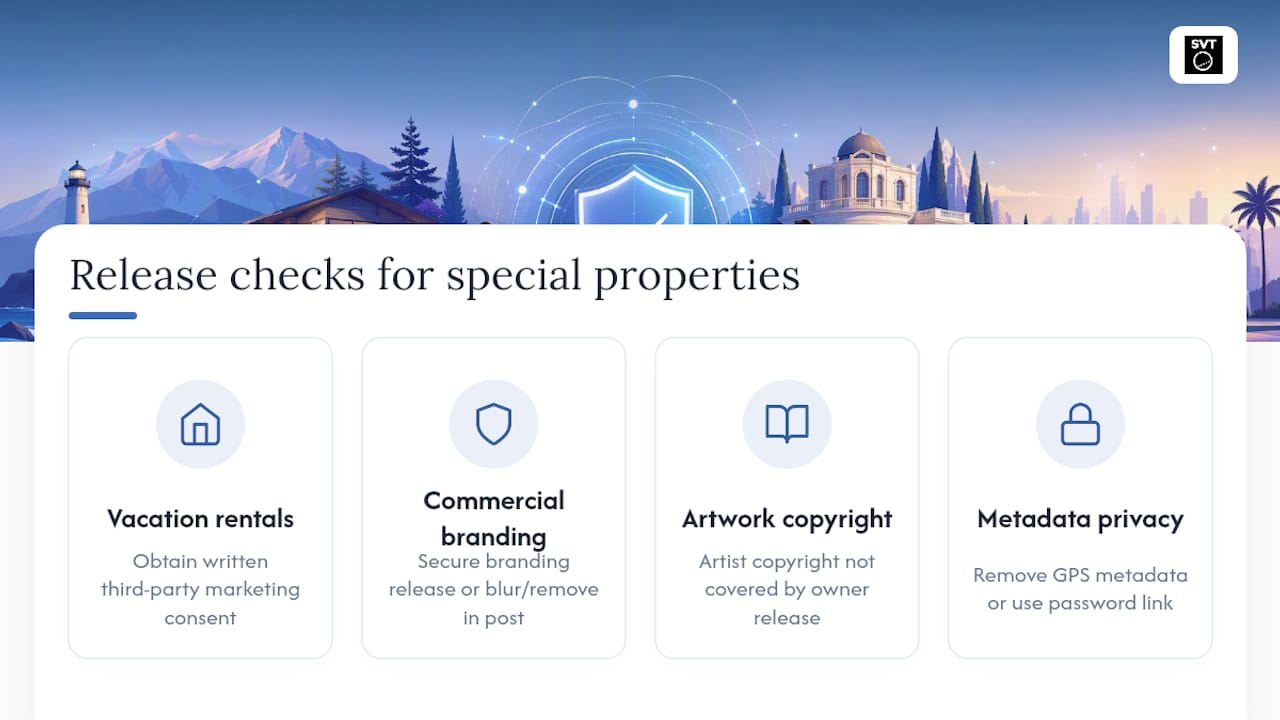
Vacation rentals are the most common trap. Listing a property on Airbnb or VRBO as a commercial rental doesn't automatically grant you rights to market it through your own virtual tour. Get written confirmation from the owner or property manager that third-party marketing is permitted, separate from whatever platform terms the rental itself operates under.
Commercial interiors carry their own risk, especially when branded signage, logos, or trademarked displays are visible. Either secure a release covering that branding specifically or blur and remove it in post-production. Artwork on display in a home or gallery introduces a similar problem: the property owner's release doesn't automatically cover the artist's copyright, so treat visible artwork as a separate rights question and exclude it from the tour if you can't clear it.
Metadata deserves its own line of attention. GPS geotags and embedded address data can identify a property even when the release situation is murky. Stripping that metadata, or limiting your embed to a private, password-protected link, is a practical fallback that reduces exposure while you sort out documentation. Our guide on GDPR compliance for virtual tours covers the privacy side of this in more depth.
How to Collect, Store, and Retain Signed Releases
Treat release collection as a repeatable workflow, not a one-off task you improvise every time.
- Identify the rights holder using the verification steps covered earlier.
- Present the release before you shoot, not after, so there's no pressure to publish while paperwork is pending.
- Attach a visual reference, like a listing photo, directly to the document.
- Collect the signature and a photo ID. Wet signatures work, and standard e-signature methods are widely accepted as long as the package captures a timestamp and the signer's identity.
- Store and index the file in a system that ties it directly to the tour record.
| Step | What to capture | Why it matters |
|---|---|---|
| Signing | Signature, printed name, date, ID scan | Prevents disputes over who agreed and when |
| Storage | PDF saved to cloud storage with backup | Protects against lost paperwork during audits |
| Linking | Release file tied to the specific tour record | Speeds up MLS or platform compliance checks |
| Fallback | Password-protected embed or redacted metadata | Reduces exposure when no release exists yet |
If a release genuinely isn't available, your safest fallback is a password-protected virtual tour with limited distribution rather than a public, fully indexed listing.
Using Simple Virtual Tour to Manage Releases and Publishing Risk
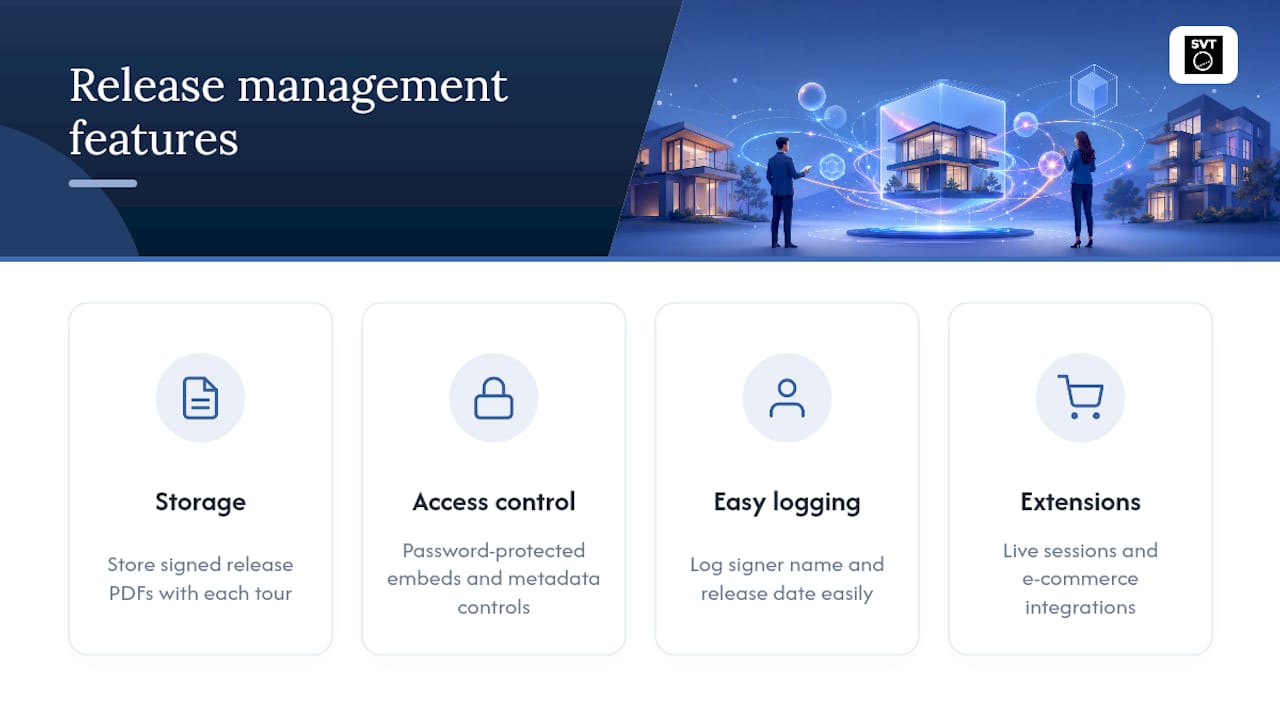
Simple Virtual Tour's self-hosted and cloud deployment options give you a place to store signed release PDFs directly alongside the tour they cover, instead of hunting across email threads and shared drives. Password-protected embeds and metadata controls let you publish selectively while paperwork is pending, and the platform's intuitive backend makes logging details like signer name and release date straightforward even without technical staff. Features like live sessions and e-commerce integration extend well beyond release management, but the storage and access controls solve a specific, recurring headache for agents juggling multiple listings at once.
Treat Releases as Business Protection, Not Paperwork
Skipping a release feels efficient right up until a homeowner disputes how their kitchen ended up on a competitor's marketing site, or a platform pulls your tour mid-campaign over a compliance flag. The agents who avoid that mess aren't the ones who move fastest. They're the ones who run the same release process on every listing, every time, without exceptions for the properties that seem "obviously fine." Speed matters in this business, but a five-minute signature beats a legal letter six months later. Pick one template, use it consistently, and treat the paperwork as part of the shoot itself rather than an afterthought you'll get to eventually.
— Andrea
Manage Releases and Publishing Controls With Simple Virtual Tour
This software provides a single place to attach signed releases, control who sees a tour before it's ready, and decide exactly how much metadata gets published, without paying agency retainers or juggling multiple storage systems to keep a listing defensible.
Password protection and self-hosting mean you're never stuck choosing between publishing fast and publishing safely. You control the embed, the access, and the record trail, whether you're running one listing a month or fifty. Getting started takes minutes: start your trial today and set up your first protected tour before your next listing goes live.
Templates and Guidance Worth Downloading
Review Getty Images' property release template for standard clause language, Stocksy's guidance on when releases apply, and a real-world photo and video release example for practical wording you can adapt. For documenting property geometry accurately before you attach a visual reference, 3D laser scanning services offer useful reference material too.
Sources
- When do I need a property release? – Frequently Asked Questions
- Property Release (Getty Images) — English — March 2026
- PHOTO/VIDEO RELEASE — The Real Estate Inspection Company
- Capture 3D Virtual Tours with Free 3D Home App | Zillow
FAQ
Does Zillow Allow Virtual Tours?
Yes. Zillow's 3D Home platform supports 3D virtual tours captured through supported devices and syndicates them across listings, though publishing broadly still depends on having proper rights to the property shown.
What Is a Property Release in Real Estate?
It's a signed agreement giving you permission to use images or video of a property commercially, covering scope of rights, permitted uses, and consideration in exchange for that permission.
What Is the Best Virtual Tour Software for Real Estate?
The right choice depends on whether you need cloud convenience or self-hosted control. Simple Virtual Tour supports both models along with password-protected embeds and metadata controls, which matter directly for managing publishing risk around unreleased properties.
Do I Need a Release for a Vacation Rental Tour?
Yes, generally. Listing a property commercially on a platform like Airbnb doesn't substitute for a release, so get written confirmation from the owner or manager that third-party marketing is permitted.
Can I Publish a Tour Without a Signed Release?
You can reduce risk by stripping geotags and publishing through a private or password-protected embed, but broad public distribution without any release carries real legal exposure.