

There are eight distinct types of venue walkthroughs, and each one has a specific job. For pre-contract screening, use a site visit or a self-guided 360° virtual tour. To shortlist with stakeholders, run a private viewing or a live-guided virtual session. For final logistics confirmation, schedule an in-person final walkthrough 24–48 hours before your event. Here is the full taxonomy at a glance:
- Initial site visit — pre-contract; planner-led technical and operational assessment
- Private viewing — pre-booked, one-on-one tour for shortlisted venues
- Open day — open-house format; ideal for early-stage exploration
- Venue fair — open day plus vendor booths; best for mid-stage planning
- Final walkthrough — 24–48 hours pre-event; domain experts verify logistics
- Self-guided 360° virtual tour — remote screening at any stage
- Live-guided virtual walkthrough — hosted remote session for stakeholder Q&A
- Hybrid walkthrough — recorded tour plus live overlay for distributed teams
Use virtual tours to pre-screen, private viewings to shortlist, and the final walkthrough to lock logistics.
Table of Contents
- What are the main types of venue walkthroughs?
- When should you use each walkthrough type?
- What should your walkthrough checklist cover?
- Technical documentation and accessibility: what to verify on-site
- How to integrate virtual tours into your inspection workflow
- How Simple Virtual Tour supports walkthrough workflows
- Key Takeaways
- The walkthrough type most planners skip
- Simple Virtual Tour shortens your screening process
- Useful sources
What are the main types of venue walkthroughs?
Every venue inspection falls into one of two broad families: in-person and virtual. Understanding the difference between a sales-led venue tour and a planner-led venue walkthrough matters from the start. A standard tour is designed to impress. A walkthrough is designed to verify.
In-person formats cover the full planning arc. The initial site visit is your pre-contract, planner-led inspection — you bring your own checklist and lead the session. The final walkthrough happens 24–48 hours before the event and focuses entirely on operational readiness: floor plans, load-in routes, and last-minute adjustments.
The three informal formats serve different stages. A private viewing is a pre-booked, one-on-one tour conducted by a venue coordinator — best for couples or planners who have already narrowed their shortlist. An open day is a relaxed, open-house event where multiple visitors tour at once, with rooms dressed for an event; no RSVP is usually required. A venue fair adds local vendor booths to the open-day format, making it useful for mid-stage planners who want to evaluate the venue and meet suppliers in one visit.

Virtual formats work across every stage. A self-guided 360° tour lets remote stakeholders explore at their own pace. A live-guided virtual walkthrough is a hosted session where a coordinator walks participants through the space in real time, fielding questions. A hybrid walkthrough combines a recorded 360° tour with a live Q&A layer, useful for distributed planning teams.
When should you use each walkthrough type?
Matching the right format to your planning objective saves time and prevents costly surprises.
| Walkthrough Type | Primary Objective | Best Timing | Typical Duration |
|---|---|---|---|
| Initial site visit | Technical and operational verification | Pre-contract | — |
| Private viewing | Shortlist confirmation | Post-open day | — |
| Open day | Early-stage exploration | Early planning | — |
| Venue fair | Mid-stage vendor + venue evaluation | Mid planning | 1–2 hours |
| Final walkthrough | Logistics lock-in | 24–48 hours pre-event | 2–3 hours |
| Self-guided 360° tour | Remote pre-screening | Any stage | — |
| Live-guided virtual tour | Stakeholder Q&A, remote sign-off | Shortlist stage | — |
| Hybrid walkthrough | Distributed team verification | Pre-contract or final | — |
One scheduling principle applies across all in-person formats: visit at the same time of day as your planned event. Natural light, acoustic behavior, and staff cadence all shift between morning and evening, and you need to see the version of the space your guests will experience.
For large U.S. events, the initial site visit and final walkthrough are non-negotiable. The informal formats and virtual sessions can compress or expand depending on your timeline and geography.
What should your walkthrough checklist cover?
A structured checklist prevents the "halo effect" — the tendency to rate a venue highly because the staged rooms looked beautiful, while missing a loading dock that cannot fit your AV truck. Organize your inspection into these groups:
- Capacity and sightlines: confirmed seated and standing capacity, stage visibility from all sections, column obstructions
- Load-in and logistics: loading dock location, elevator dimensions, corridor widths, and staging constraints
- AV and technical specs: patch panel locations, rigging points, ceiling heights, house sound system specs
- Power and connectivity: circuit capacity (amps per circuit), dedicated circuits for production, Wi-Fi vs. wired bandwidth, backup power availability
- Safety and accessibility: emergency exits, ADA-compliant routes, accessible restrooms, hearing loop availability
- Guest experience: parking, wayfinding, coat check, restroom ratios
- Service culture: staff responsiveness during the visit, operational tone, vendor coordination history
- Contract and fine print: exclusivity clauses, preferred vendor lists, overtime fees, cancellation terms
Pro Tip: Photograph every technical element with a timestamp and a reference object for scale. A photo of a loading dock without a person or tape measure in frame is nearly useless when you are briefing an AV vendor remotely.
Record technical specs in a dedicated table during every site visit:
| Spec | What to Measure | Why It Matters |
|---|---|---|
| Ceiling height | Feet from floor to lowest obstruction | Determines rigging and truss options |
| Circuit capacity | Amps per circuit, number of dedicated circuits | Prevents production power failures |
| Loading dock height | Inches from ground | Determines truck compatibility |
| Freight elevator | Interior dimensions (W × D × H), weight limit | Limits equipment size and weight |
| Rigging points | Number, location, rated load per point | Defines lighting and AV hang options |
| Wi-Fi bandwidth | Mbps upload/download, number of access points | Critical for live-streaming events |
Technical documentation and accessibility: what to verify on-site
Logistics details like corridor widths and freight elevator sizes determine whether your setup is physically feasible — and discovering a problem after you have signed a contract is expensive. Walk every load-in route with your AV tech or production manager present.
For U.S. venues, ADA compliance checkpoints include: step-free access from parking to all event spaces, accessible restroom locations on each floor, hearing loop or assistive listening system availability, and clearly marked accessible routes throughout the venue. Ask the venue coordinator for their most recent ADA compliance documentation rather than relying on a verbal assurance.
Document every finding with a photo, a measurement, and a labeled note. Share that package with your vendors before load-in day. If a technical fix is required after booking — say, a temporary power run or a ramp installation — get the cost and timeline in writing before signing.
How to integrate virtual tours into your inspection workflow
Virtual tours are most effective as pre-walkthrough filters, not replacements for in-person verification. Here is a practical five-step protocol:
- Remote pre-screening: Publish or request a self-guided 360° tour. Eliminate venues that clearly fail on capacity, layout, or aesthetic before scheduling any travel.
- Live-guided stakeholder session: Host a live virtual walkthrough for remote decision-makers. Use this to gather questions and get preliminary sign-off before committing to an in-person visit.
- In-person site visit: Bring your checklist and at least one technical lead. Focus on the items a virtual tour cannot confirm: acoustics, power infrastructure, load-in feasibility, and service culture.
- Mid-planning check (if needed): Return for a second in-person visit if the event brief changes significantly after the initial site visit.
- Final walkthrough: Schedule 24–48 hours pre-event. Bring the people who will run their domain on event day — AV technicians, catering lead, stage manager — so each can verify equipment fit and access points for their gear.
For virtual-tour creators, this workflow points to specific production decisions: tag technical hotspots with embedded notes (ceiling height, circuit locations, dock dimensions), embed measurement metadata in the tour, and leave guided annotations that speed the in-person checklist for planners who visit after screening remotely.
How Simple Virtual Tour supports walkthrough workflows
Simple Virtual Tour is built for exactly this kind of hybrid inspection workflow. The platform lets you publish self-guided 360° tours that remote stakeholders can explore independently, and it supports live session hosting for real-time guided walkthroughs with Q&A. You can embed custom hotspots to tag technical specs — ceiling heights, power outlet locations, load-in routes — directly inside the tour, so vendors receive a briefing package before they ever set foot in the venue.
The platform's dual deployment model (cloud-hosted or self-hosted) gives data-sensitive clients full control over their tour assets, which matters for large corporate events or venues with confidentiality requirements. With over 1,400 users across real estate, tourism, and event spaces, Simple Virtual Tour covers the full range of venue showcase needs from early-stage marketing to pre-event vendor coordination.
Key Takeaways
Combining virtual pre-screening with structured in-person walkthroughs and a final logistics check 24–48 hours before the event gives planners the most complete picture of any venue.
| Point | Details |
|---|---|
| Use virtual tours to pre-screen | Self-guided 360° tours eliminate unsuitable venues before any travel is scheduled. |
| Schedule the final walkthrough at 24–48 hours | Confirm floor plans, load-in routes, and operational details with domain experts present. |
| Bring technical leads to in-person visits | AV techs and catering leads verify equipment fit and access points that planners cannot assess alone. |
| Document with a structured checklist | Record measurements, photos, and labeled notes to avoid memory bias when comparing venues. |
| Simple Virtual Tour for hybrid workflows | The platform supports self-guided tours, live sessions, and embedded technical hotspots for vendor handoffs. |
The walkthrough type most planners skip
Most planners treat the initial site visit as a formality — a chance to confirm the venue looks like the photos. That is a mistake. The site visit is the only moment before you sign a contract when you have full leverage to ask hard questions, walk every load-in route, and test staff responsiveness without the pressure of an imminent event.
Service culture — how quickly the coordinator responds to your questions, whether they know the circuit capacity off the top of their head, how they handle an unexpected request during the tour — is one of the strongest predictors of how a venue will perform on event day. You cannot assess that from a 360° tour or a brochure. The planners who skip a thorough site visit and rely on virtual tours alone tend to discover operational problems during the final walkthrough, when there is almost no time to fix them.
The sequence that works: screen remotely, shortlist with a live virtual session, verify technically in person, and lock logistics at the final walkthrough. Each step has a job. None is optional.
Simple Virtual Tour shortens your screening process
If you are managing multiple venue evaluations at once, the time spent on early-stage in-person visits adds up fast. Simple Virtual Tour gives you a faster path: publish interactive 360° tours that remote clients and stakeholders can explore on their own schedule, then host a live guided session when they are ready for a walkthrough with Q&A. Embed technical hotspots directly in the tour so your vendors receive load-in specs, ceiling heights, and power notes before load-in day — no separate briefing document required.
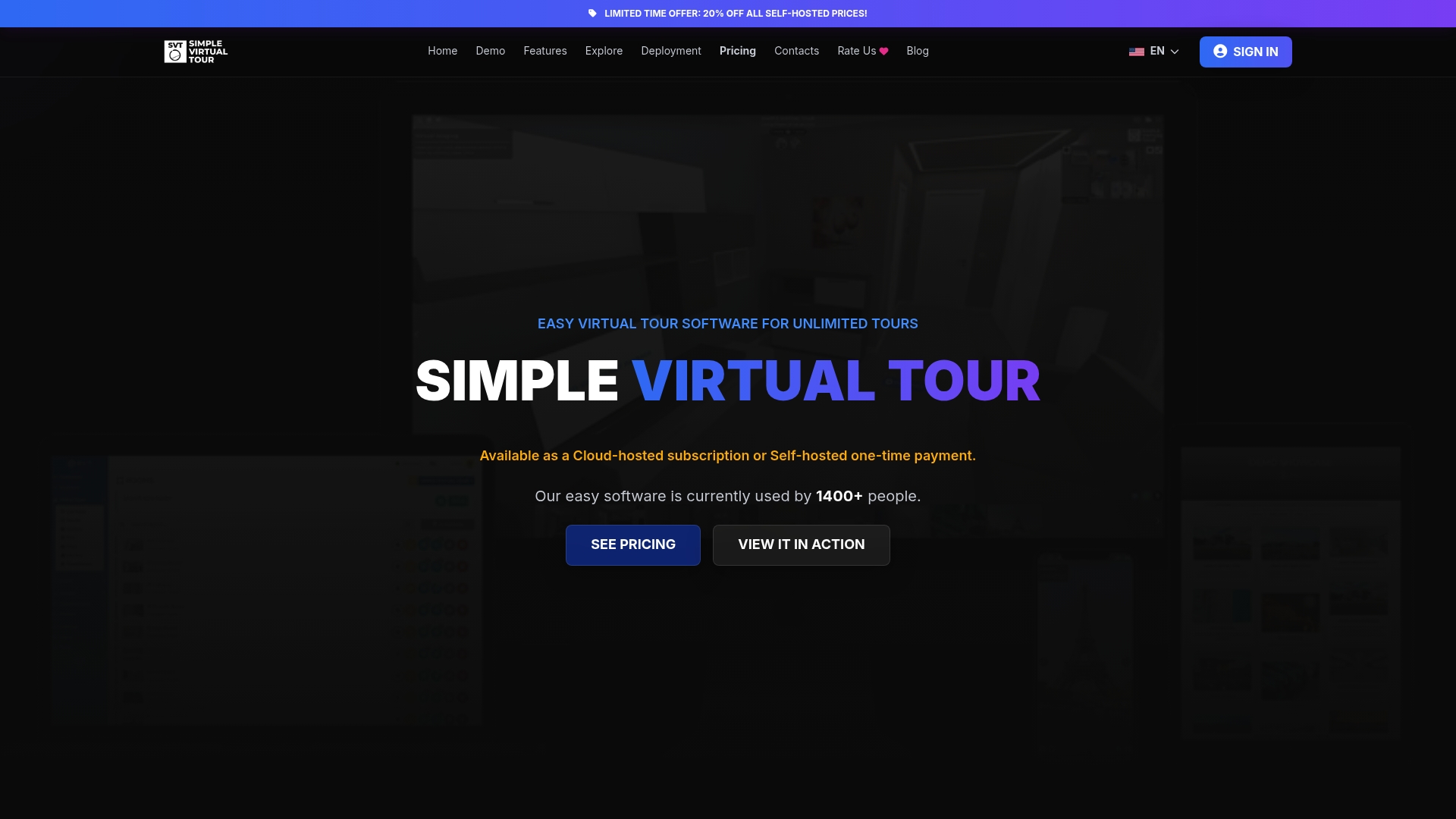
Both cloud-hosted and self-hosted options are available, so you choose the deployment that fits your data and budget requirements. Start with Simple Virtual Tour and cut the time between first contact and venue sign-off.
Useful sources
Checklists and walkthrough guides
- The Complete Venue Walkthrough Checklist — ExpoPass
- 7 Steps to a Successful Event Venue Walkthrough — Zkipster
- How Venue Walkthroughs Support Reliable Event Logistics — Peanut Productions
- The Art of the Site Visit: A Guide for Event Planners — Conference Innovations
- What Is a Site Visit and What Should I Look For? — DMC Go
Venue visit formats
- All the Types of Venue Events: Why Visiting Venues Is Crucial — Bridebook
Simple Virtual Tour resources
- Showcase Event Space Online Tour: A Venue Manager's Guide
- Live Virtual Venue Tour Hosting: A Pro Guide for 2026
- Venue Showcase Digital Tools for Professionals: 2026
- Why Virtual Tours Support Hybrid Event Planning