

Self-hosted virtual tours are defined as interactive digital experiences deployed on infrastructure you own and control, rather than rented from a third-party SaaS platform. This distinction is the core reason why self-hosted tours reduce recurring costs so dramatically. Organizations that switch from subscription-based platforms to self-hosted solutions eliminate monthly fees, platform commissions, and per-transaction charges in a single move. Research shows self-hosted stacks can achieve a 97.5% cost reduction over five years compared to SaaS marketplace subscriptions. That figure is not a rounding error. It reflects the compounding weight of fees that SaaS models charge every month, whether you use the platform heavily or not.
Why self-hosted tours reduce recurring costs: the subscription math
The most direct financial driver is the elimination of monthly platform fees. Typical SaaS virtual tour platforms charge between $299 and $499 per month. Over five years, that totals between $17,940 and $29,940 in subscription costs alone, before any transaction or commission fees.
Online travel agencies and booking platforms add another layer of cost. OTA commissions typically run 15–30% of each booking. For a business generating $100,000 in annual tour revenue, that means $15,000 to $30,000 leaves the business every year before a single operating expense is paid. Self-hosted direct-booking setups eliminate that drain entirely.

The contrast becomes stark when you compare total cost of ownership. One detailed analysis found that a SaaS marketplace model incurred over $33,000 in subscription and transactional fees over five years. A self-hosted equivalent required only minor hosting costs for the same period. The gap is not marginal. It is structural.
Pro Tip: Calculate your current monthly SaaS fee multiplied by 60 (five years) and add your average annual OTA commission spend. That total is the ceiling of what self-hosting can save you.
Three cost categories disappear or shrink significantly when you self-host:
- Monthly subscription fees: No recurring platform charge for access to your own content
- Per-transaction commissions: You retain 100% of direct booking revenue
- Seat or user fees: Many SaaS platforms charge per user account; self-hosted solutions do not
- Forced upgrade costs: SaaS vendors raise prices; your self-hosted license does not change
The self-hosted vs cloud comparison makes clear that the upfront investment in a self-hosted license pays for itself within the first year for most mid-size organizations.
How digital self-guided tours cut operational expenses
Cost savings from self-hosting extend well beyond software fees. Physical operational costs, including printed brochures, maps, and guided staff hours, represent a significant recurring expense for tourism organizations, museums, real estate firms, and hospitality businesses.
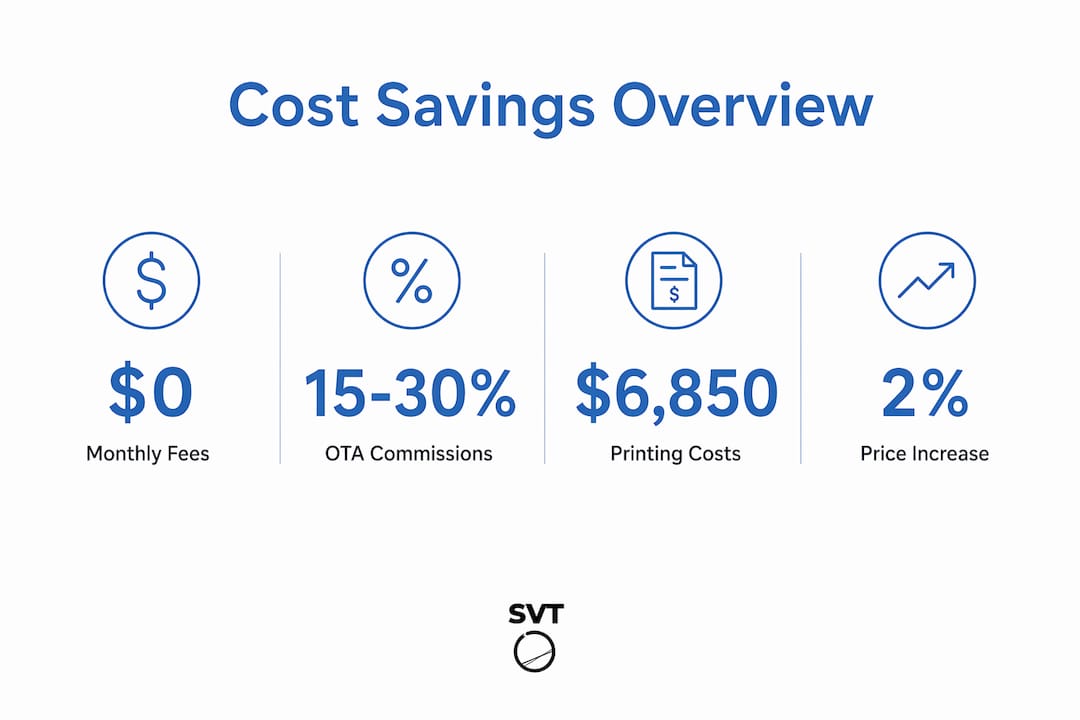
One cultural organization saved $6,850 in printing costs alone by switching to digital self-guided tour formats. That saving recurs every year because digital content updates are free, while reprinting brochures for every content change is not. The math compounds quickly for organizations that update their offerings seasonally.
Staffing costs follow the same logic. Traditional guided tours require a staff member present for every group, at every time slot. Self-guided tours serve unlimited visitors simultaneously with no additional labor cost. That is a structural shift in unit economics, not just a marginal efficiency gain.
Pro Tip: Map your current annual spend on printed materials and guided tour staff hours before evaluating a self-hosted solution. This baseline makes the ROI calculation concrete and defensible to stakeholders.
The scalability advantage compounds over time:
- A single digital tour asset serves one visitor or ten thousand with identical cost
- Content updates publish instantly at no incremental expense
- Tours operate 24 hours a day, 7 days a week, without overtime or scheduling constraints
- Geographic reach expands to global audiences without physical presence
Properties using virtual tours also achieve approximately 2% higher closing prices, according to research published in the Journal of Real Estate Literature. That return goes beyond cost avoidance. It represents direct revenue improvement from the same digital asset.
What technical responsibilities affect your total savings?
Self-hosting transfers platform control to you. That control is the source of the savings, but it also transfers technical responsibility. Understanding these responsibilities upfront prevents the hidden costs that erode the financial advantage.
-
Server uptime management: Your hosting environment must maintain reliable availability. Downtime means lost visitor access and potential booking failures. Managed hosting partners handle this automatically, but unmanaged servers require internal monitoring.
-
Security patching: Self-hosted software requires regular updates to plugins, frameworks, and the core application. Neglecting security updates exposes your platform to vulnerabilities that can result in data breaches or service interruption.
-
Database backups: Automated, scheduled backups protect your tour content and visitor data. Without a backup protocol, a server failure can mean permanent data loss.
-
Plugin and integration updates: Third-party integrations, such as booking engines or e-commerce modules, require periodic compatibility checks after core software updates.
-
Troubleshooting time: Teams that spend 40 or more hours resolving technical issues should count that time as a real cost against the savings from self-hosting. Time has a dollar value.
The practical solution for most organizations is a managed hosting partner rather than fully unmanaged infrastructure. This approach preserves the cost advantage while offloading the technical overhead to professionals. The 2026 cost savings guide from Simple Virtual Tour covers this tradeoff in detail for organizations at different technical maturity levels.
What strategic advantages come with data ownership?
Cost savings are the immediate benefit of self-hosting. Data ownership is the long-term strategic advantage that most organizations undervalue at the point of purchase.
Self-hosted platforms keep all visitor and customer data on your own infrastructure. Full data sovereignty means you control who accesses that data, how it is stored, and how long it is retained. This is not just a privacy preference. It is a compliance requirement under regulations like GDPR, and it becomes more critical as privacy laws expand globally.
Platform independence is equally significant. When you rely on a SaaS provider, that vendor controls your pricing, your feature set, and your ability to export your content. Vendors raise prices, change terms, or shut down entirely. Self-hosted organizations face none of those risks.
Key strategic benefits of owning your digital tour infrastructure include:
- Brand control: No third-party watermarks, forced branding, or platform-mandated design restrictions
- Vendor independence: Your content and data remain accessible regardless of any vendor's business decisions
- Custom integrations: Connect your tour platform to your CRM, booking engine, or analytics stack without vendor approval
- Long-term asset value: Your tour library grows as a proprietary digital asset, not as content locked inside someone else's platform
The role of virtual tours in listing conversion illustrates how this asset value compounds over time, particularly in real estate and hospitality where tour libraries represent years of content investment.
Key Takeaways
Self-hosted virtual tours reduce recurring costs by eliminating SaaS subscription fees, OTA commissions, and physical operational expenses, while delivering scalable digital assets your organization fully owns and controls.
| Point | Details |
|---|---|
| Subscription fees eliminated | Self-hosting removes $299–$499 monthly SaaS platform fees, saving thousands annually. |
| OTA commissions avoided | Direct-booking self-hosted setups retain 15–30% of revenue lost to platform commissions. |
| Operational costs reduced | Digital self-guided tours eliminate printing and staffing expenses, saving thousands per year. |
| Technical oversight required | Security, backups, and uptime management must be handled internally or via a managed host. |
| Data sovereignty gained | Self-hosted infrastructure keeps visitor data on your servers, supporting GDPR compliance and brand control. |
The real tradeoff most businesses miss
I have worked with organizations that went into self-hosting expecting pure savings with no strings attached. The savings are real. The 97.5% five-year cost reduction figure is not marketing language. But the organizations that realize those savings fully are the ones that treat self-hosting as a capability investment, not just a cost-cutting move.
The businesses that struggle are the ones that underestimate the technical layer. They switch to self-hosting, save on fees for six months, then spend those savings on emergency troubleshooting when a plugin update breaks their booking flow. The solution is not to avoid self-hosting. The solution is to budget for managed hosting from day one and treat it as a fixed operational cost, not an optional extra.
What I find genuinely underappreciated is the data ownership angle. Most decision-makers focus on the subscription math, which is fair because the numbers are compelling. But the real long-term value is building a proprietary digital asset library that no vendor can hold hostage. When a SaaS platform shuts down or doubles its pricing, self-hosted organizations keep operating without interruption. That resilience has a financial value that does not show up in a simple fee comparison.
My advice: evaluate self-hosting not just as a way to cut costs, but as a way to build durable digital infrastructure. The cost savings fund the capability. The capability compounds over time.
— Andrea
Simple Virtual Tour: built for self-hosted cost savings
Organizations ready to act on these savings need a platform that makes self-hosting practical, not just theoretically cheaper.
Simple Virtual Tour offers a self-hosted virtual tour solution with a one-time license, unlimited tour creation, and an intuitive backend that requires no technical expertise to operate. Over 1,400 organizations already use it to create interactive virtual tours with full data control, live session capabilities, and e-commerce integration. The platform's dual deployment model lets you choose between cloud-hosted and self-hosted, so you can match your infrastructure to your team's capabilities. If you are ready to eliminate recurring platform fees and own your digital tour assets outright, see the full platform and choose the plan that fits your organization.
FAQ
What exactly makes self-hosted tours cheaper than SaaS platforms?
Self-hosted tours replace monthly subscription fees and per-transaction commissions with a one-time license and modest hosting costs. Over five years, this difference can reach 97.5% in total cost reduction.
Do self-hosted tours require technical staff to manage?
Self-hosted platforms require someone to handle security updates, backups, and uptime monitoring. Organizations without internal technical staff should use a managed hosting partner to cover these responsibilities cost-effectively.
How do self-hosted tours eliminate OTA commissions?
Self-hosted direct-booking setups process reservations through your own infrastructure, bypassing online travel agencies entirely. This retains the 15–30% commission that OTAs would otherwise deduct from each booking.
Are self-hosted virtual tours GDPR-compliant?
Self-hosted platforms store all visitor data on your own servers, giving you direct control over data retention and access. This makes GDPR compliance significantly more straightforward than relying on a third-party SaaS provider's data policies.
How quickly do self-hosted tour platforms pay for themselves?
Most mid-size organizations recover the upfront license cost within the first year by eliminating monthly SaaS fees and OTA commissions. Operational savings from reduced printing and staffing accelerate that payback timeline further.