

Virtual experiences are immersive digital tools that tourism boards use to engage potential visitors, reduce booking friction, and increase physical visitation rates. The industry term for this practice is "virtual destination marketing," and it has moved well beyond novelty. Research confirms that virtual tours directly trigger visit intention by improving how travelers feel about a destination before they ever book a flight. Tourism boards that understand why virtual experiences work, not just that they work, build programs that convert curiosity into confirmed trips. Simple Virtual Tour is one platform helping tourism professionals put this strategy into practice at scale.
Why tourism boards use virtual experiences to influence travel decisions
Virtual experiences change how travelers think and feel about a destination. A structural equation modeling study of 476 tourists confirmed that virtual tours improve destination attitudes, and those improved attitudes directly increase the likelihood of booking a real visit. That finding matters because it shifts virtual experiences from "nice to have" into a measurable part of the conversion funnel.
The psychological impact works through two distinct channels:
- Hedonic value: The experience is enjoyable and emotionally engaging. Travelers feel excited about a place after exploring it virtually, which builds positive associations.
- Utilitarian value: The experience answers practical questions. Travelers learn about layout, accessibility, crowd levels, and what to expect, which reduces uncertainty.
Both channels matter, but the utilitarian channel is often underestimated. Tourism boards that focus only on making virtual tours beautiful miss the functional half of the equation. Ease of use also plays a critical role. When a virtual experience is hard to navigate, the technical usability gap breaks the connection between interest and intention. A traveler who gets frustrated with a clunky interface does not convert, regardless of how stunning the destination looks.
Pro Tip: Test your virtual experience on a mobile device before publishing. Most travelers encounter destination content on their phones first, and a tour that works perfectly on desktop but lags on mobile loses the audience you most need to reach.
Tourism boards that meet modern traveler expectations by providing immersive previews see measurable gains in visitor confidence. Static images no longer satisfy travelers who want to understand a place before committing to it.

How virtual experiences function as confidence tools, not promotional gimmicks
The most important shift in virtual destination marketing is the move from novelty to utility. Early virtual tours were impressive because they were new. That novelty effect fades. What sustains engagement, and what actually drives bookings, is the confidence a virtual experience builds in the traveler's mind.
Tourism boards that reposition virtual experiences as operational service layers see better long-term results. This means treating a virtual tour not as a promotional video but as a functional tool that answers the questions travelers ask before they commit. Those questions include:
- Can I navigate this destination with limited mobility?
- How far is the hotel from the main attractions?
- What does the beach actually look like at ground level, not from a drone?
- Is the market area crowded and chaotic, or calm and walkable?
A well-built virtual experience answers all four. This is what researchers call the "phygital extension" model. Virtual previews extend the physical journey backward in time, giving travelers a realistic sense of what they will encounter. The phygital framework repositions virtual content as a bridge between the decision phase and the physical trip, not a replacement for it.
Inclusivity is another underappreciated benefit. Just 3 minutes of VR tourism content provides measurable psychological relaxation and cognitive detachment, as confirmed by clinical EEG studies. For travelers with anxiety about unfamiliar environments, this is a genuine service. Tourism boards that offer accessible virtual previews signal that they care about all visitors, not just the most confident ones.
Pro Tip: Add a dedicated accessibility section to your virtual tour. Show ramp access, elevator locations, and quiet areas. This single addition can meaningfully expand your audience and reduce pre-trip support calls.
What forms of virtual experiences complement physical tourism strategies
Not all virtual experiences are the same, and choosing the right format depends on what your destination needs to communicate.
Static virtual tours
A static virtual tour uses 360-degree photography to let travelers explore a destination at their own pace. This format works well for hotels, historic sites, and venues where the physical environment is the main selling point. Static tours are cost-effective to produce and easy to embed on destination websites. They also improve session duration and reduce bounce rates, which sends positive signals to search engines and improves organic visibility over time.
Dynamic digital twins
Digital twins are interactive, real-time replicas of physical spaces. A study of digital twin adoption in Spain found that trust and ease of use are the primary factors that predict whether travelers actually use them. Digital twins go further than static tours by showing layout, flow, and accessibility in real time before a traveler books. A convention center, for example, can use a digital twin to show event planners exactly how a space configures for different group sizes.
| Format | Best use case | Key advantage |
|---|---|---|
| Static 360 virtual tour | Hotels, historic sites, beaches | Low production cost, easy to embed |
| Digital twin | Venues, cities, convention centers | Real-time layout and accessibility data |
| AI-powered immersive content | Large destinations, multi-site campaigns | Personalized exploration paths |
AI-powered immersive content adds a layer of personalization that static tours cannot match. Travelers can filter experiences by interest, mobility needs, or travel style, which makes the virtual preview more relevant and more likely to convert. For local business discovery, this format also helps tourism boards highlight smaller attractions that travelers might otherwise overlook.
The most effective multi-channel approach integrates virtual experiences directly into the booking workflow. When a traveler can move from a virtual tour to a booking form without leaving the page, friction drops and conversion rates rise. Tourism boards that treat virtual content as a standalone marketing asset, separate from the booking process, leave conversions on the table.
How do tourism boards measure ROI from virtual experiences?
Tourism boards measure ROI from virtual experiences through session duration, bounce rate reduction, booking lift, and cost-per-impression comparisons against paid advertising.
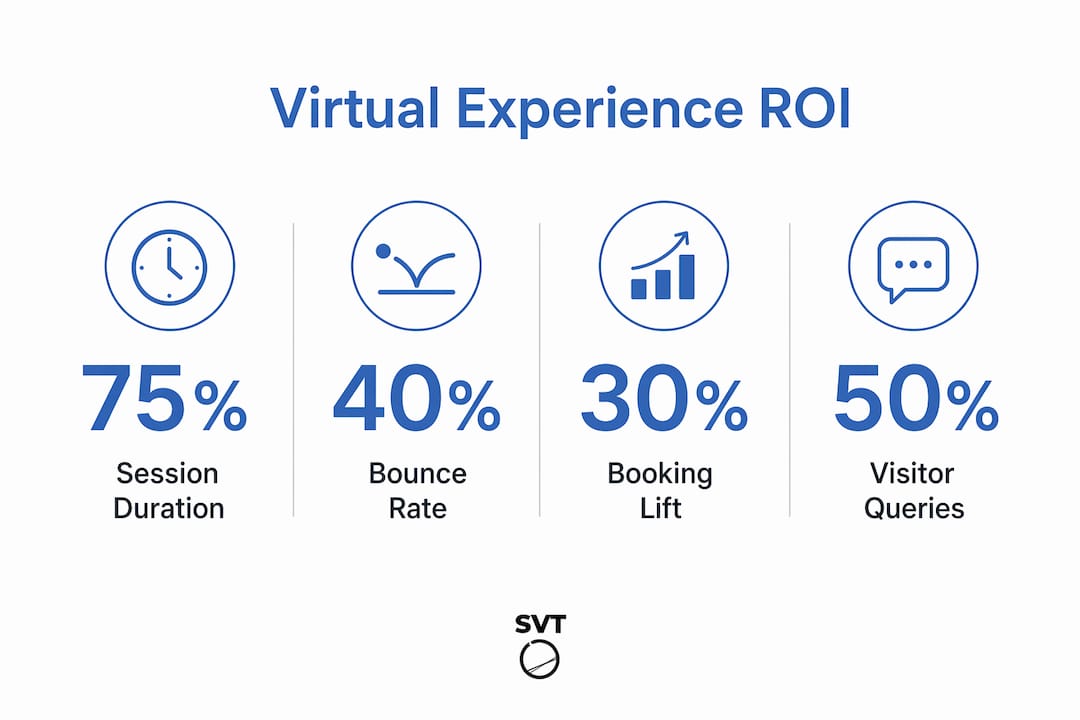
Virtual tours produce higher long-term ROI than paid ads because they remain available continuously. A paid campaign stops delivering the moment the budget runs out. A virtual tour keeps working, keeps answering visitor questions, and keeps improving SEO signals for months or years after publication. That longevity fundamentally changes the cost calculation.
The SEO benefit is concrete. Search engines reward pages where visitors spend more time and engage more deeply. A destination page with an embedded virtual tour holds attention longer than a page with static images. That extended engagement signals relevance, which improves organic rankings and reduces the need for paid traffic.
Pro Tip: Track the specific pages where your virtual tour is embedded and compare their organic ranking trajectory against comparable pages without tours. The difference in ranking velocity is usually visible within 90 days.
Stakeholder adoption of virtual reality in tourism accelerated significantly during the COVID-19 period, driven by perceived usefulness rather than novelty. Twenty in-depth stakeholder interviews confirmed that knowledge and practical utility were the primary adoption drivers. That finding has a direct implication for ROI measurement: tourism boards that track utility metrics, such as how many visitor questions a virtual tour answers or how many support calls it eliminates, get a fuller picture of the return than those who track impressions alone.
Visitor questions reduction is a real, measurable outcome. When a virtual tour clearly shows parking access, entrance locations, and the general flow of a site, the volume of pre-trip inquiries to visitor centers drops. That reduction has a direct cost saving attached to it, which belongs in any honest ROI calculation.
For destination venue sales, virtual tours also shorten the sales cycle. Event planners and group travel buyers who can explore a venue virtually before a site visit arrive with better questions and faster decisions.
Key Takeaways
Tourism boards that treat virtual experiences as functional confidence tools, not just promotional content, consistently see stronger visitor conversion and long-term ROI.
| Point | Details |
|---|---|
| Confidence over novelty | Virtual experiences work best when they answer practical visitor questions, not just showcase aesthetics. |
| Phygital integration | Linking virtual previews directly to booking workflows reduces friction and increases conversion rates. |
| Format selection matters | Choose static tours, digital twins, or AI-powered content based on what your destination needs to communicate. |
| Long-term SEO value | Virtual tours improve session duration and organic rankings, delivering returns long after publication. |
| Storytelling sustains engagement | Deep cultural content prevents novelty fade and keeps travelers curious about a destination over time. |
The uncomfortable truth about virtual tourism strategy
I have reviewed a lot of virtual destination marketing programs, and the pattern is consistent. Tourism boards that invest in virtual experiences primarily because they look impressive in board presentations almost always underperform. The technology is not the strategy. The visitor's question is the strategy.
The boards that get real results start with a different question. They ask: what does a traveler need to know before they feel confident enough to book? Then they build the virtual experience to answer that. That sounds obvious, but sustained visitor engagement comes from storytelling depth, not technology novelty. Most programs get this backward.
The other mistake I see repeatedly is treating the virtual experience as the end of the digital journey rather than the beginning of the physical one. The best programs I have seen connect the virtual tour directly to the booking page, the local guide download, and the accessibility information sheet. The virtual experience is the entry point, not the destination. When you build that phygital connection deliberately, the conversion numbers follow.
My practical recommendation: audit your current virtual content against a list of the ten most common questions your visitor center receives. If your virtual tour does not answer at least seven of them, you have a gap that is costing you bookings.
— Andrea
How Simple Virtual Tour helps tourism boards build effective virtual experiences
Tourism boards need virtual experience tools that are practical to deploy and easy to maintain without a dedicated technical team. Simple Virtual Tour is built for exactly that situation.
Simple Virtual Tour gives tourism professionals the ability to create unlimited interactive virtual tours with an intuitive backend that requires no coding knowledge. The platform supports both cloud-hosted and self-hosted deployments, which means your destination data stays under your control. With features including live session capabilities, e-commerce integration, and full customization, it fits destinations of any size. Over 1,400 users already rely on it to present spaces and engage visitors effectively. If you are ready to put a real virtual experience program in place, explore Simple Virtual Tour and see what the platform can do for your destination.
FAQ
Why do tourism boards use virtual experiences?
Tourism boards use virtual experiences to improve destination attitudes, reduce booking uncertainty, and directly increase visit intention. Research with 476 tourists confirms that virtual tours trigger travel decisions by making travelers feel more confident and informed.
Do virtual tours actually increase bookings?
Virtual tours improve session duration, reduce bounce rates, and create measurable booking lift. Tourism boards report that virtual content delivers higher long-term ROI than paid advertising because it remains available and functional indefinitely.
What is the difference between a virtual tour and a digital twin?
A virtual tour uses 360-degree photography for immersive exploration, while a digital twin is a dynamic, real-time replica that shows layout, flow, and accessibility data. Digital twins are better suited for complex venues and large destinations where spatial understanding drives booking decisions.
How do virtual experiences help travelers with anxiety or accessibility concerns?
Just 3 minutes of VR tourism content produces measurable psychological relaxation, as confirmed by clinical EEG studies. Virtual previews also allow travelers to assess accessibility features before arriving, which reduces uncertainty and broadens the audience a destination can serve.
How does storytelling improve virtual tour performance?
Storytelling depth prevents the novelty fade that affects purely visual virtual tours. Research shows that destinations combining immersive technology with rich cultural content sustain visitor curiosity and convert more explorers into actual travelers over time.